Buying signals: the complete guide
A buying signal is observable evidence that an account may be moving toward a decision your product can help with. They matter because timing decides deals: 6sense found 94% of B2B buying groups rank their preferred vendors before ever contacting sales. Reach the right account at the right moment and you get in before the shortlist closes. Used badly, signals become a creepy dashboard that pretends to read minds. This guide covers what counts as a signal, 15 examples by strength, and how to act on them without overclaiming.
Published . Reviewed for freshness, claim boundaries, and current sales signal logic on .
What are buying signals?
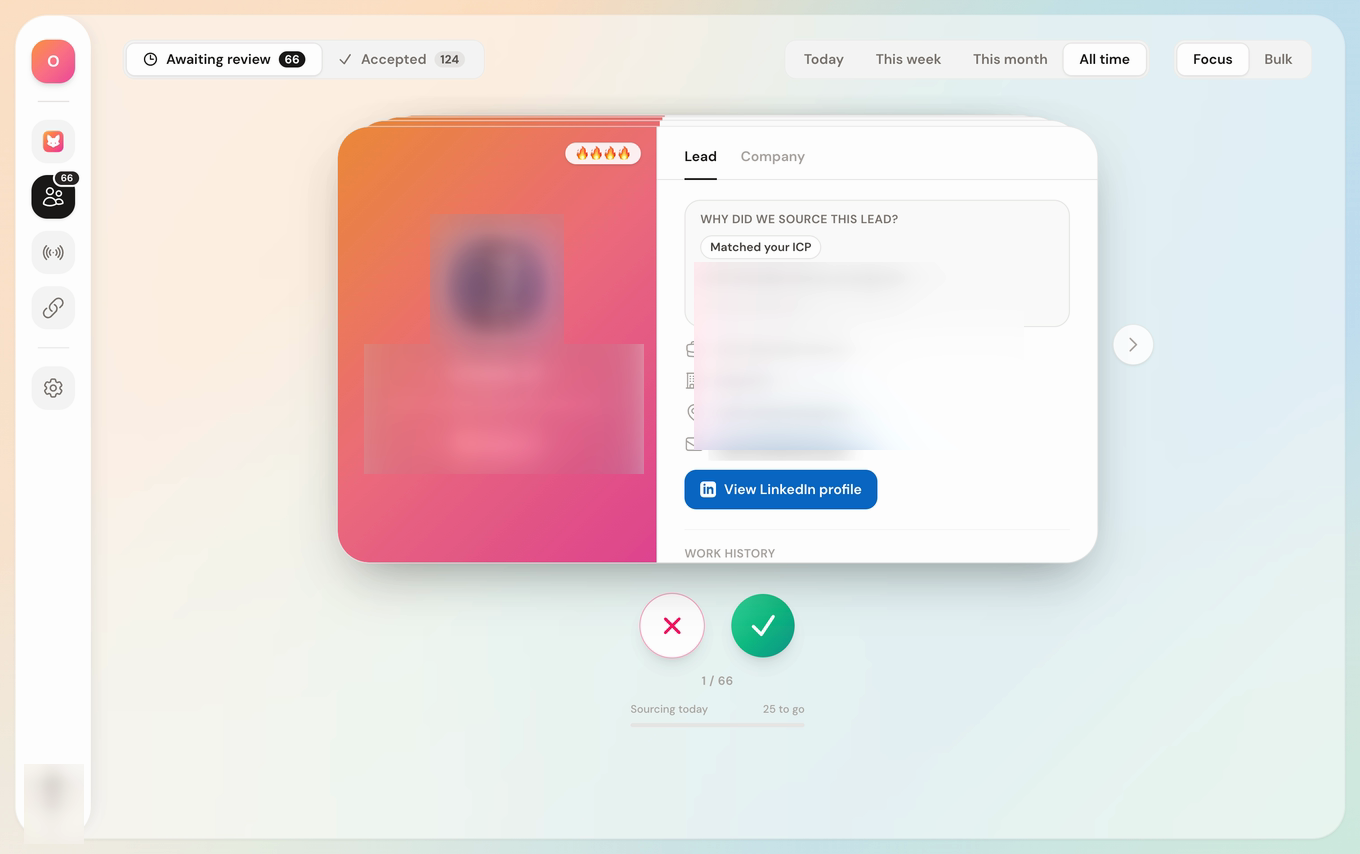
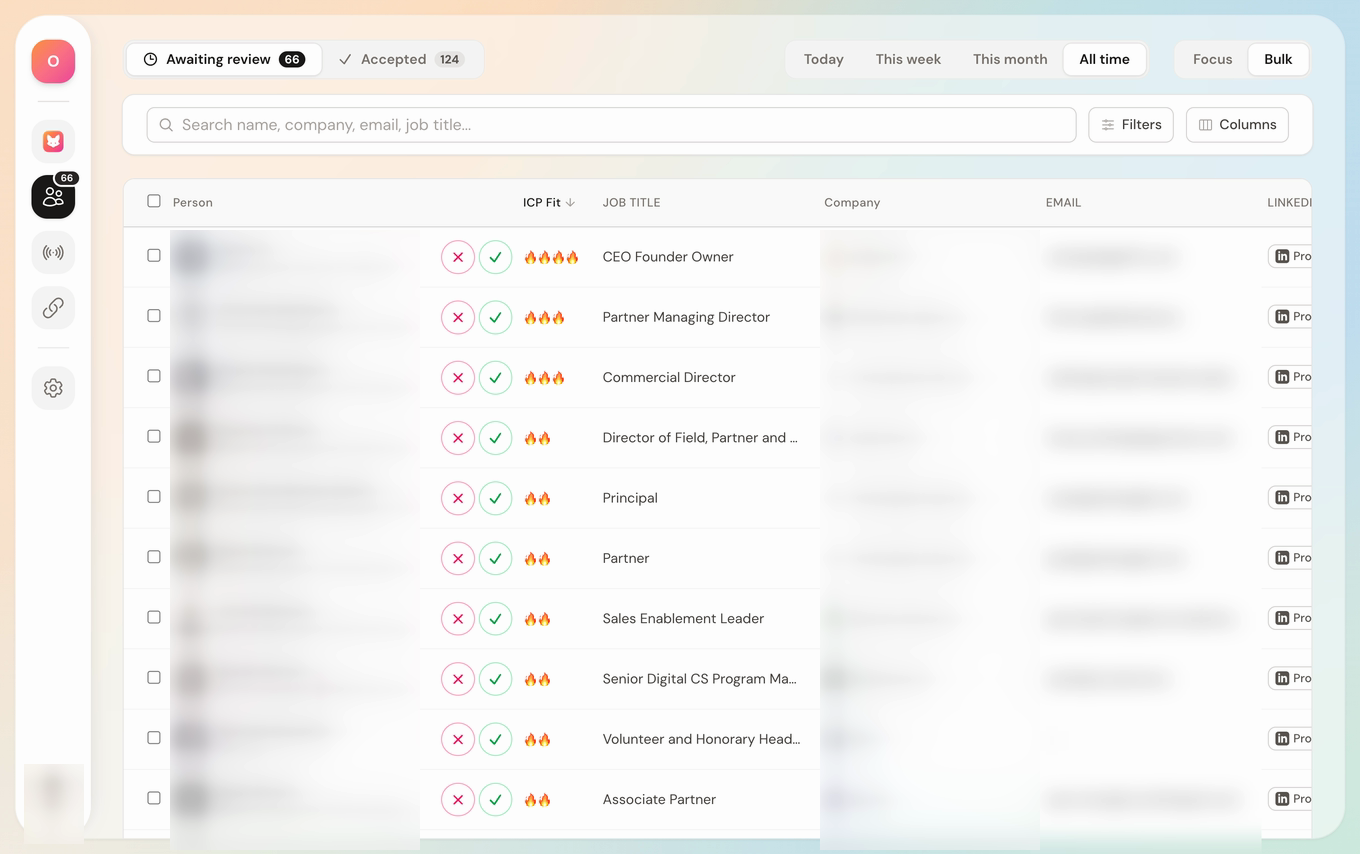
Buying signals are observable events or behaviors that suggest an account may have a reason to act now: hiring, funding, job changes, website and LinkedIn activity, competitor mentions, tech-stack changes, and corporate events. A signal is evidence, not proof of intent. The useful workflow is to combine the signal with best-fit account rules, judge problem ownership and recency, then send a human-approved message that references the business situation rather than the tracked behavior. max runs that loop end to end.
How to act on a buying signal
- 01
Confirm fit
A signal only matters on an account that already matches your best-fit profile.
- 02
Classify the signal
Decide what it actually proves versus what it only hints at.
- 03
Score it
Rank by source strength, recency, buyer relevance, and problem ownership.
- 04
Choose a useful asset
Pick a teardown, checklist, or benchmark that helps the buyer decide.
- 05
Send a human-approved touch
Reference the business situation, never the tracked behavior.
Why timing decides the deal
Buying signals matter because most of the decision happens before you ever talk to the buyer. The data is stark.
- 94% of B2B buying groups rank their preferred vendors before contacting sales (6sense, 2025)
- Buyers reach their first vendor contact only about 61% of the way through the journey (6sense, 2025)
- Nearly 90% of B2B buyers had a purchase stall in 2023 (Forrester)
- Short lists are shrinking to 2 to 3 options, and 71% of buyers buy their top choice (TrustRadius, 2024)
What counts as a buying signal
A buying signal is any public, first-party, or consent-safe piece of evidence that an account's situation has changed in a way that creates a reason to act. The change can be in the team (a new hire), the money (funding), the stack (a tool swap), the market (a competitor move), or the behavior (a pricing-page visit). The signal is the clue. The buyer situation it points to is what actually matters.
- Observable: you can point to the event or behavior
- Recent: timing is the whole reason a signal beats a static list
- Relevant: it maps to a problem your product can credibly solve
- Attributable: it sits on a best-fit account, not a random company
Buying signals, intent signals, intent data: same idea, different words
The terms overlap. Intent data usually means third-party data about topic research and content consumption. Intent signals and buying signals are broader: any evidence of timing, including first-party behavior and public company events. Signal-based selling is the practice of using that evidence to decide who to contact and why now. The label matters less than the discipline: evidence in, judgement applied, useful message out.
- Intent data: third-party topic and content-consumption data
- Intent and buying signals: any evidence of timing, public or first-party
- Signal-based selling: the workflow that turns either into a decision
Strong signals versus weak signals
Not all signals carry the same weight. A funding round or a relevant senior hire is a strong signal: it implies budget and a likely owner. A single LinkedIn like is a weak signal: it shows topic curiosity at best. Weak signals are only useful when they are stacked with account fit and a stronger signal. Treating a weak signal as proof of intent is the fastest way to send a message that reads as surveillance.
- Strong: funding, senior hires, recruitment campaigns, tech-stack changes, tenders
- Medium: job changes, repeated website visits, competitor mentions
- Weak: a lone reaction, a follow, a single page view
- Rule: a weak signal needs fit plus a stronger signal before outreach
15 buying signals to track, by strength
A practical signal program does not track everything; it tracks the events that map to your offer and ranks them by how much they actually prove. Here are fifteen common B2B buying signals, grouped by strength. Strong signals can justify outreach on their own when account fit is there; weak signals only count when stacked with fit and a stronger signal.
- Strong: new funding round announced
- Strong: a relevant senior leader hired (VP Sales, Head of Growth)
- Strong: a recruitment campaign opening several roles in one function
- Strong: a tech-stack change or tool migration
- Strong: a published RFP or public tender that matches your offer
- Strong: a merger or acquisition that triggers integration work
- Medium: a key contact changes jobs to a best-fit account
- Medium: repeat visits to your pricing or comparison pages
- Medium: a competitor mention or migration question in public
- Medium: a website relaunch, rebrand, or new market entry
- Medium: sustained paid-search spend with weak organic coverage
- Weak: a single LinkedIn post reaction or comment
- Weak: a new follow of your or a competitor's page
- Weak: one anonymous visit to a blog post
- Weak: engagement with an industry influencer's post
Fit plus timing: the only score that matters
A signal on the wrong account is noise. The score that drives action combines best-fit profile match with signal strength, recency, and problem ownership. An account with perfect fit and a fresh, strong signal goes to the top of the queue. A perfect-fit account with no signal waits. A strong signal on a non-fit account is ignored, however tempting the event looks.
- Account fit
- Signal strength
- Recency
- Problem ownership
- Source permission
The evidence boundary: act on signals without being creepy
The message should reference the business situation, not the tracked behavior. Say 'teams scaling sales usually hit a ramp problem' after a hiring signal, not 'I saw you posted three SDR roles.' Use only public, first-party, or consent-safe evidence, and never imply you know private budget or intent. This is not just etiquette: messages that reference the problem outperform messages that reference the surveillance.
- Reference the problem, not the signal
- Use public, first-party, or consent-safe sources only
- Never claim private intent or budget
- Keep a human approval step before send
How this brief was reviewed.
- Freshness
- Updated June 15, 2026. This page was checked for current signals language, metadata quality, schema coverage, internal links, and whether the advice still reflects signal-led sales in 2026.
- Editorial review
- Reviewed by max research team. The brief is written from max's sales operating model: best-fit customer profile first, evidence second, human-approved outreach third. It avoids claiming private intent or guaranteed outcomes.
- Method
- This guide uses public sales signals, safe outreach boundaries, buyer timing logic, and campaign examples that a prospect can recognize. Recommendations are framed as decision support for sales teams, not as legal, deliverability, or revenue guarantees.
Questions buyers ask before acting.
Keep the thread.
- New signal
Job change signal
Eskimos Inc. just changed CEO, they might rebuild their process and need help with new tools.
Job change signal
Use job changes as an intent signal for B2B lead generation, LinkedIn outreach, and email campaigns with max.
- New signal
Funding announcement signal
Mistral closed a €600M Series B, the new budget unlocks tooling and sales headcount decisions.
Funding announcement signal
Use funding announcements as B2B lead generation signals for timely LinkedIn and email campaigns with max.
Turn intent signals into outbound campaigns
A practical max playbook for turning best-fit customer rules, intent signals, account prioritization, LinkedIn outreach, and email copy into a campaign launch.
The practical test is simple: can the system explain why this specific account deserves a human touch now, using evidence the buyer would recognize?
Turn buying signals into campaigns with max