
The best outbound tools for agencies, compared for 2026

Nicolas Finet·Updated 27 min read

The answer in 60 seconds

How should you evaluate outbound tools for agencies?

There is no evidenced universal winner among outbound tools for agencies. Define the job, non-negotiable constraints, operating owner, and success measure first; then test the independent candidates below on the same real task. Each card separates vendor-documented facts from the still-unknown result of that test. Because Max publishes this guide, it is excluded from the independent shortlist and evaluated in a separate disclosed block.

Choosing among outbound tools for agencies starts with the job your current workflow does not solve. This brief gives you narrow facts from first-party pages checked July 21, 2026, plus one criterion, repeatable proof, evidence log, and rejection rule to apply before you buy. Recheck current pricing, packaging, and limits at source.

Published . Last materially updated .

Source checkGoogle Search Central: Write High Quality Reviews

Open the primary source (opens in a new tab)

Supports
The editorial method for useful comparisons: demonstrate expertise, show evidence, discuss benefits and drawbacks, identify decision factors, and explain what distinguishes an option.
Doesn’t prove
Search-quality guidance, not an endorsement of this shortlist or proof that a comparison will rank. Direct product claims still require product-level evidence.
Use this guideMap the client service before assembling the agency stackLearning goals

Frame the decision

A useful comparison of outbound tools for agencies starts with the job you need done, not with the longest feature list. For this decision, use one written criterion: Define client-specific ICP logic, data permissions, tenant separation, approvals, sending ownership, suppression, reporting, branding, incident response, exports, and the handoffs between data, decision, and execution tools.

By the end, you will be able to shortlist outbound tools for agencies by running “Build and offboard two client campaign workspaces” and applying a rejection rule written before the test.

After this guide, you can

  1. 01Turn this category decision into a checkable brief: Define client-specific ICP logic, data permissions, tenant separation, approvals, sending ownership, suppression, reporting, branding, incident response, exports, and the handoffs between data, decision, and execution tools.
  2. 02Apply the same proof to every finalist: Use two contrasting client briefs to build isolated campaign packets and sandbox executions, correct one account rule, process one opt-out, produce a client report, and export or offboard both workspaces.
  3. 03Keep the required evidence and enforce the stop rule: Record setup, cross-client leakage tests, approval trace, account and message corrections, suppression, report definitions, operator time, tool handoffs, offboarding, and retained-margin assumptions. Reject a stack that cannot isolate clients, preserve approvals and suppression, expose the source of claims, or be operated profitably by the team named in the service model.

The field note turns this page’s criterion, proof, evidence log, and stop rule into a reusable evaluation sheet. It is not a ranking or an automatic purchase rule.

Reduce the shortlist

Start with the job, not a winner

Pick the output you actually need. The names in each lane have at least one dated first-party claim that explicitly documents that job; select a name to inspect its evidence card.

Decision in 30 seconds

Reduce the list before opening vendor demos

  1. 01 · Required job

    Choose one lane below. Treat every candidate without dated first-party evidence for that job as a research gap.

  2. 02 · Non-negotiable

    Define client-specific ICP logic, data permissions, tenant separation, approvals, sending ownership, suppression, reporting, branding, incident response, exports, and the handoffs between data, decision, and execution tools.

  3. 03 · Test and stop

    Use two contrasting client briefs to build isolated campaign packets and sandbox executions, correct one account rule, process one opt-out, produce a client report, and export or offboard both workspaces.

    Reject when: Reject a stack that cannot isolate clients, preserve approvals and suppression, expose the source of claims, or be operated profitably by the team named in the service model.

  • Find target people or companies

    Create a searchable list with the people or accounts the team needs.

    2
    Why these names appear
    • Apollo: Apollo documents People search across its person database using filters such as persona, job title, location, and company size; saved results can be enrolled in a sequence, exported to CSV, or added to a list.
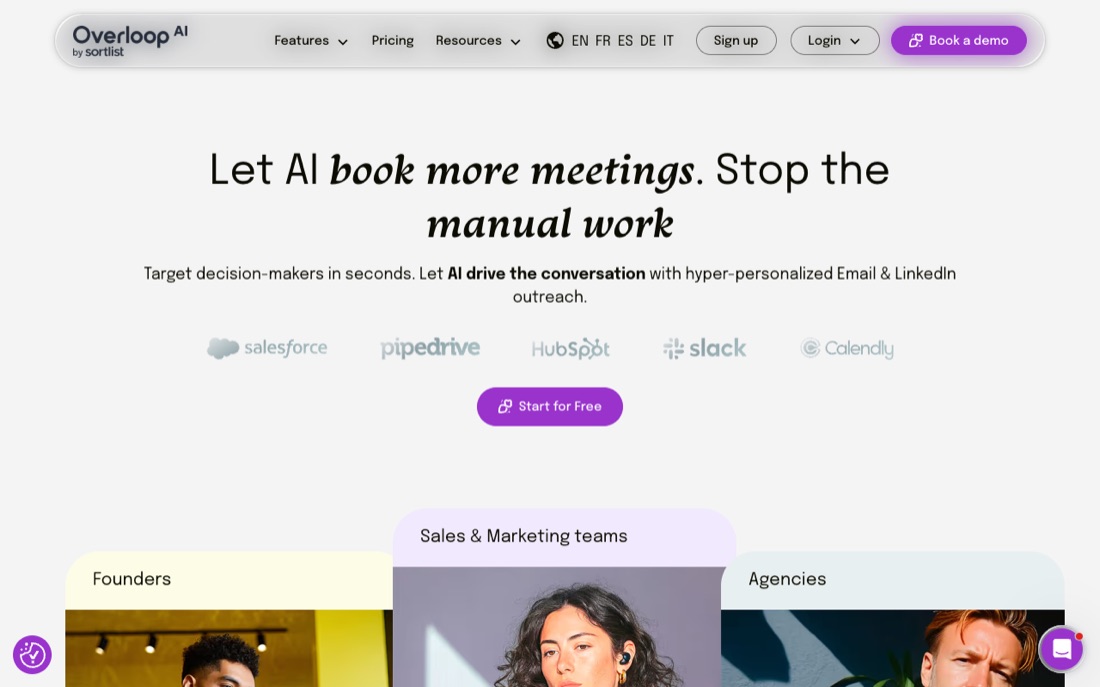
    • Overloop: Overloop documents an integrated contact database and AI-generated multichannel sequences spanning email and LinkedIn, including sequence steps, timing, messages, and follow-ups.
  • Enrich or refresh existing records

    Fill required fields on records you already hold and preserve their destination.

    1
    Why these names appear
    • Clay: Clay documents table-based enrichment waterfalls that query multiple providers in a chosen order, stop once a provider returns the required data, and can expose the successful provider.
  • Build and run email sequences

    Turn an approved audience and message into a controlled email workflow.

    5
    Why these names appear
    • Apollo: Apollo documents Sequences as planned, customizable outreach campaigns whose touchpoints can include emails, phone calls, social engagement, and rep tasks.
    • Clay: Clay's native Sequencer can create and run email campaigns inside Clay and trigger campaigns when an enrichment detects a selected signal.
    • lemlist: lemlist documents multichannel sequences spanning email, automated LinkedIn actions, in-app calling, voice messages, and manual tasks.
    • Overloop: Overloop documents an integrated contact database and AI-generated multichannel sequences spanning email and LinkedIn, including sequence steps, timing, messages, and follow-ups.
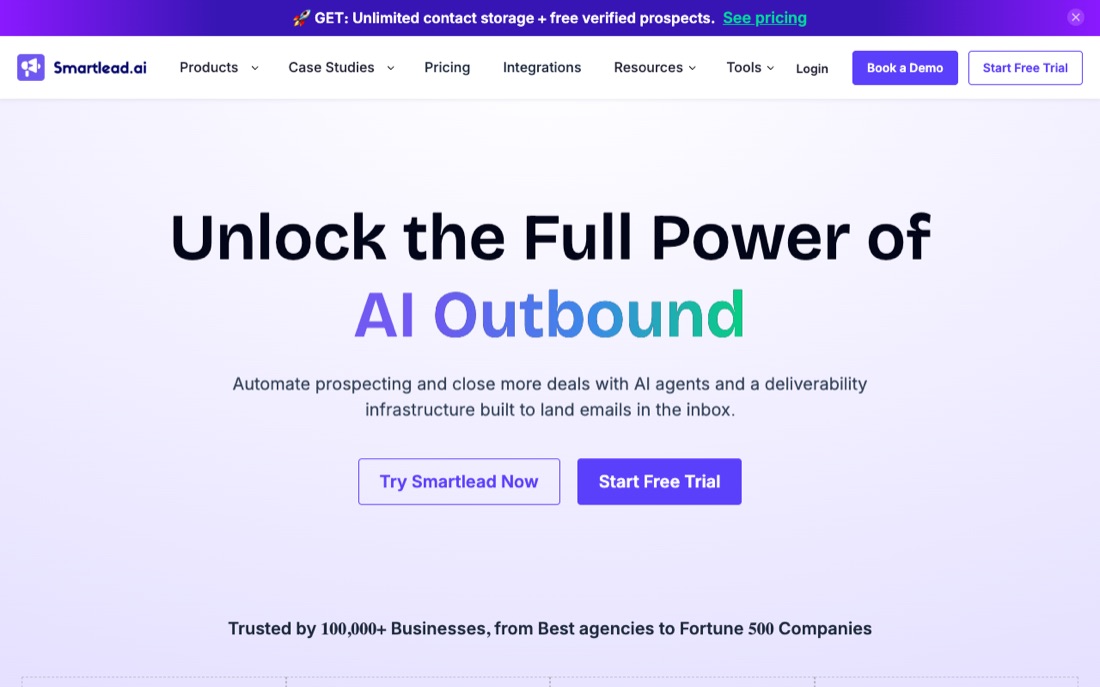
    • Smartlead: Smartlead's campaign builder combines automated email steps with manual tasks that pause a sequence until completion, including tasks for calls, LinkedIn outreach, or reply review.
  • Add documented LinkedIn steps

    Map LinkedIn research or outreach actions before applying the platform-policy gate.

    4
    Why these names appear
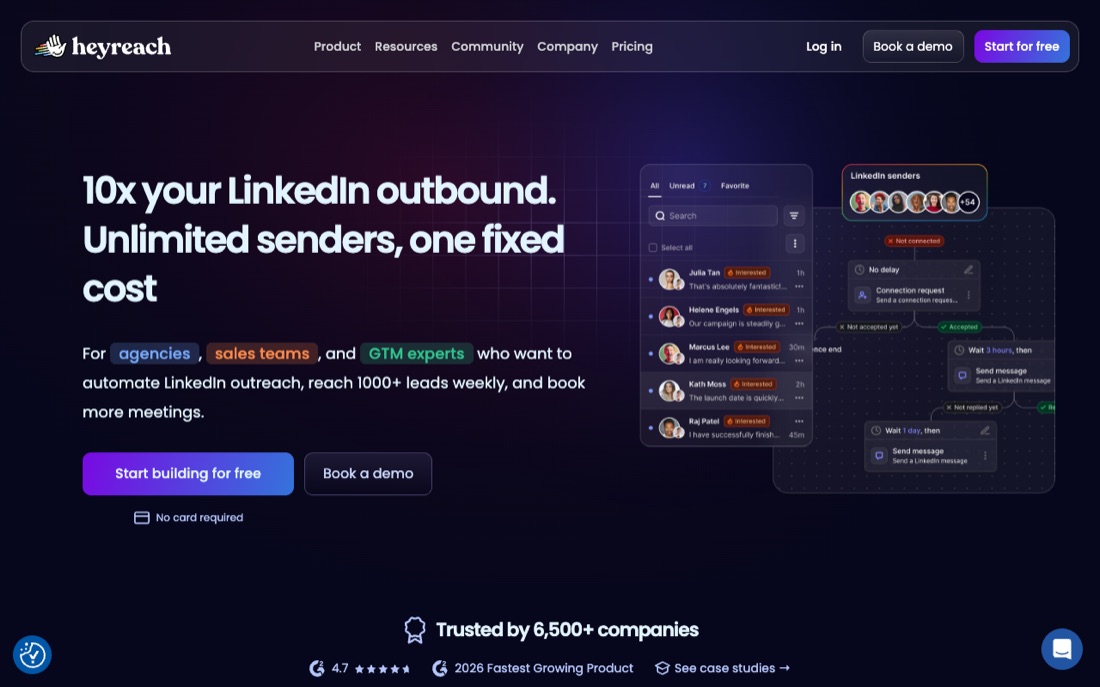
    • HeyReach: HeyReach documents LinkedIn sequence actions and branches plus hand-off steps that add leads to Smartlead, Instantly, or EmailBison.
    • lemlist: lemlist documents multichannel sequences spanning email, automated LinkedIn actions, in-app calling, voice messages, and manual tasks.
    • Overloop: Overloop documents an integrated contact database and AI-generated multichannel sequences spanning email and LinkedIn, including sequence steps, timing, messages, and follow-ups.
    • Smartlead: Smartlead's campaign builder combines automated email steps with manual tasks that pause a sequence until completion, including tasks for calls, LinkedIn outreach, or reply review.
  • Operate multiple senders or teammates

    Coordinate more than one sender or operator without treating scale as a result.

    2
    Why these names appear
    • HeyReach: A campaign can use multiple LinkedIn senders, but action limits apply per sender across campaigns and are shared when the same sender participates in more than one campaign.
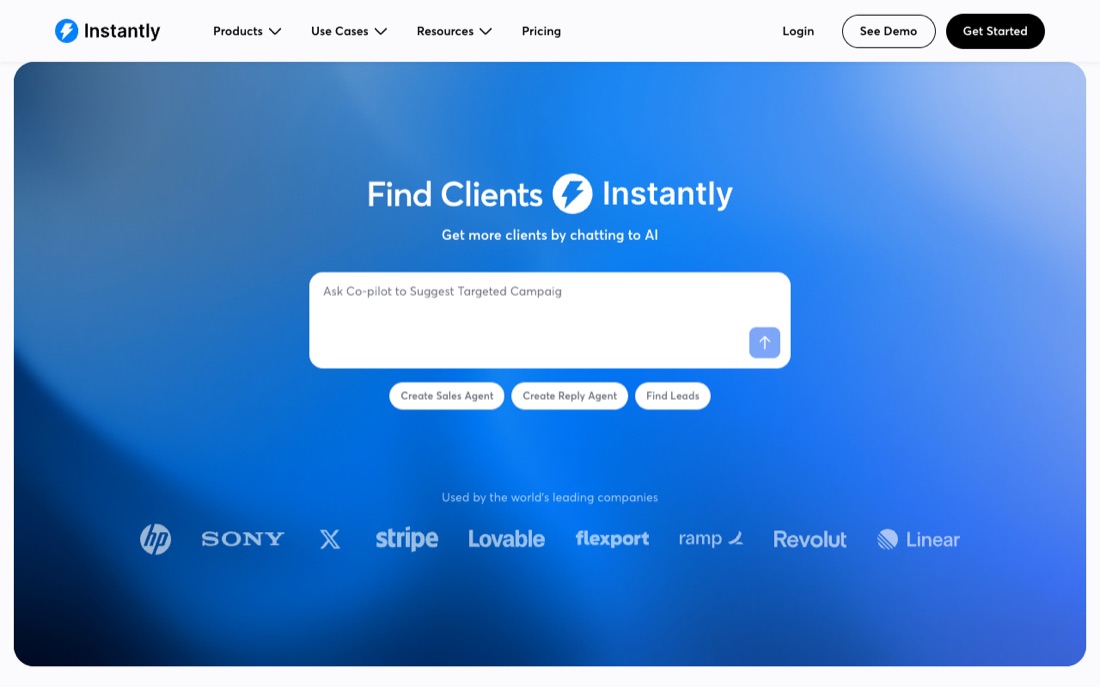
    • Instantly: Instantly documents assigning multiple sending accounts to one campaign, with campaign-level daily limits and optional text-only delivery optimization.
  • Track workflow evidence

    Keep documented campaign or manager signals for later review.

    2
    Why these names appear
    • Expandi: Expandi documents visual Smart Sequences with behavior-based if-then branches, flexible delays, per-step statistics, exclusions, and duplicate-send prevention.
    • Overloop: Its campaign reporting is documented as tracking opens, clicks, replies, bounces, and out-of-office replies.

The evaluation protocol

One proof, applied to every candidate

The list below is alphabetical, not ranked. Each card separates narrow facts found in first-party documentation from results we have not observed. Vendor documentation can establish what a product says it does; only the same-task proof can establish whether it works for your case.

  1. Criterion01

    Define client-specific ICP logic, data permissions, tenant separation, approvals, sending ownership, suppression, reporting, branding, incident response, exports, and the handoffs between data, decision, and execution tools.

  2. Same-task proof02

    Use two contrasting client briefs to build isolated campaign packets and sandbox executions, correct one account rule, process one opt-out, produce a client report, and export or offboard both workspaces.

  3. Evidence to keep03

    Record setup, cross-client leakage tests, approval trace, account and message corrections, suppression, report definitions, operator time, tool handoffs, offboarding, and retained-margin assumptions.

  4. Stop rule04

    Reject a stack that cannot isolate clients, preserve approvals and suppression, expose the source of claims, or be operated profitably by the team named in the service model.

The candidates

Build a dated evidence sheet for each option

We checked the cited first-party pages on July 21, 2026. The notes below are traceable product facts, not hands-on findings. Reopen every source because packaging and capabilities can change, then record the common proof before deciding.

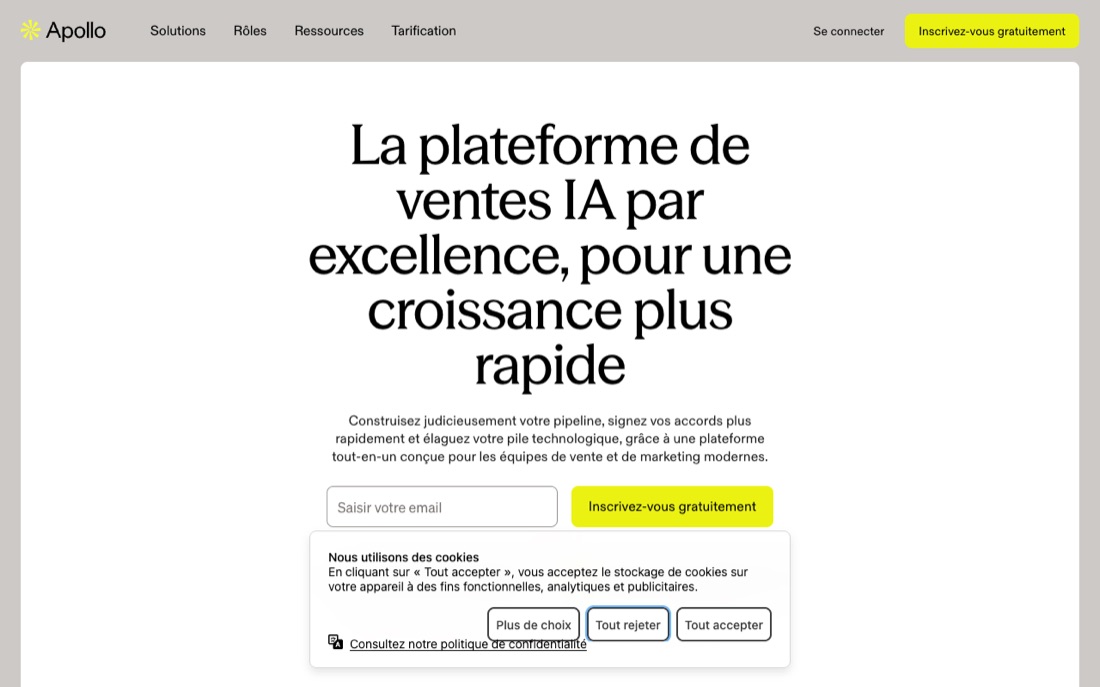
Archived public vendor-page capture for Apollo; verify the current pageOpen the full-size screenshot in a new tab
Select the image to open it full-size in a new tab. Archived for orientation only; interface and packaging may have changed.

Vendor-documented snapshot · checked July 21, 2026

  • Apollo documents People search across its person database using filters such as persona, job title, location, and company size; saved results can be enrolled in a sequence, exported to CSV, or added to a list.

    Source: Search for People – Apollo ↗
  • Apollo documents Sequences as planned, customizable outreach campaigns whose touchpoints can include emails, phone calls, social engagement, and rep tasks.

    Source: Sequences Overview – Apollo ↗

First-party documentation, not an independent hands-on result or a promise of fit.

Documentation checked · field result unknownThe facts above are vendor-authored. Inclusion is not a fit, safety, or performance verdict; the common proof still decides.
Evidence routine for Apollo+
  1. 1 · Document. For Apollo, attach dated official evidence for every item in the criterion above; mark missing answers as unknown rather than inferring them.
  2. 2 · Test. Run the common proof with Apollo. Keep the sample, inputs, reviewers, time window, and acceptance criteria unchanged.
  3. 3 · Decide. Apply the evidence requirements and stop rule to Apollo. Record pass, hold, or reject with observed results, unresolved unknowns, an owner, and a review date.


Vendor-documented snapshot · checked July 21, 2026

First-party documentation, not an independent hands-on result or a promise of fit.

Documentation checked · field result unknownThe facts above are vendor-authored. Inclusion is not a fit, safety, or performance verdict; the common proof still decides.
Evidence routine for Clay+
  1. 1 · Document. For Clay, attach dated official evidence for every item in the criterion above; mark missing answers as unknown rather than inferring them.
  2. 2 · Test. Run the common proof with Clay. Keep the sample, inputs, reviewers, time window, and acceptance criteria unchanged.
  3. 3 · Decide. Apply the evidence requirements and stop rule to Clay. Record pass, hold, or reject with observed results, unresolved unknowns, an owner, and a review date.
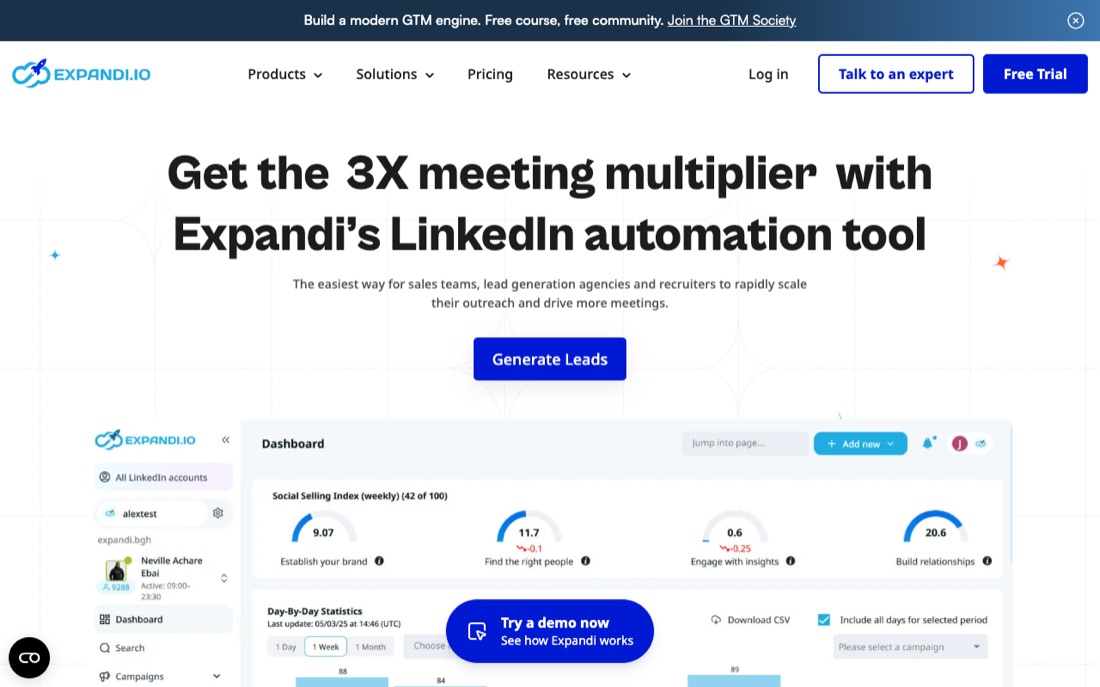
Archived public vendor-page capture for Expandi; verify the current pageOpen the full-size screenshot in a new tab
Select the image to open it full-size in a new tab. Archived for orientation only; interface and packaging may have changed.

Vendor-documented snapshot · checked July 21, 2026

First-party documentation, not an independent hands-on result or a promise of fit.

Documentation checked · field result unknownThe facts above are vendor-authored. Inclusion is not a fit, safety, or performance verdict; the common proof still decides.
Evidence routine for Expandi+
  1. 1 · Document. For Expandi, attach dated official evidence for every item in the criterion above; mark missing answers as unknown rather than inferring them.
  2. 2 · Test. Run the common proof with Expandi. Keep the sample, inputs, reviewers, time window, and acceptance criteria unchanged.
  3. 3 · Decide. Apply the evidence requirements and stop rule to Expandi. Record pass, hold, or reject with observed results, unresolved unknowns, an owner, and a review date.

Archived public vendor-page capture for HeyReach; verify the current pageOpen the full-size screenshot in a new tab
Select the image to open it full-size in a new tab. Archived for orientation only; interface and packaging may have changed.

Vendor-documented snapshot · checked July 21, 2026

First-party documentation, not an independent hands-on result or a promise of fit.

Documentation checked · field result unknownThe facts above are vendor-authored. Inclusion is not a fit, safety, or performance verdict; the common proof still decides.
Evidence routine for HeyReach+
  1. 1 · Document. For HeyReach, attach dated official evidence for every item in the criterion above; mark missing answers as unknown rather than inferring them.
  2. 2 · Test. Run the common proof with HeyReach. Keep the sample, inputs, reviewers, time window, and acceptance criteria unchanged.
  3. 3 · Decide. Apply the evidence requirements and stop rule to HeyReach. Record pass, hold, or reject with observed results, unresolved unknowns, an owner, and a review date.
Archived public vendor-page capture for Instantly; verify the current pageOpen the full-size screenshot in a new tab
Select the image to open it full-size in a new tab. Archived for orientation only; interface and packaging may have changed.

Vendor-documented snapshot · checked July 21, 2026

First-party documentation, not an independent hands-on result or a promise of fit.

Documentation checked · field result unknownThe facts above are vendor-authored. Inclusion is not a fit, safety, or performance verdict; the common proof still decides.
Evidence routine for Instantly+
  1. 1 · Document. For Instantly, attach dated official evidence for every item in the criterion above; mark missing answers as unknown rather than inferring them.
  2. 2 · Test. Run the common proof with Instantly. Keep the sample, inputs, reviewers, time window, and acceptance criteria unchanged.
  3. 3 · Decide. Apply the evidence requirements and stop rule to Instantly. Record pass, hold, or reject with observed results, unresolved unknowns, an owner, and a review date.

Archived public vendor-page capture for lemlist; verify the current pageOpen the full-size screenshot in a new tab
Select the image to open it full-size in a new tab. Archived for orientation only; interface and packaging may have changed.

Vendor-documented snapshot · checked July 21, 2026

First-party documentation, not an independent hands-on result or a promise of fit.

Documentation checked · field result unknownThe facts above are vendor-authored. Inclusion is not a fit, safety, or performance verdict; the common proof still decides.
Evidence routine for lemlist+
  1. 1 · Document. For lemlist, attach dated official evidence for every item in the criterion above; mark missing answers as unknown rather than inferring them.
  2. 2 · Test. Run the common proof with lemlist. Keep the sample, inputs, reviewers, time window, and acceptance criteria unchanged.
  3. 3 · Decide. Apply the evidence requirements and stop rule to lemlist. Record pass, hold, or reject with observed results, unresolved unknowns, an owner, and a review date.
Archived public vendor-page capture for Overloop; verify the current pageOpen the full-size screenshot in a new tab
Select the image to open it full-size in a new tab. Archived for orientation only; interface and packaging may have changed.

Vendor-documented snapshot · checked July 21, 2026

First-party documentation, not an independent hands-on result or a promise of fit.

Documentation checked · field result unknownThe facts above are vendor-authored. Inclusion is not a fit, safety, or performance verdict; the common proof still decides.
Evidence routine for Overloop+
  1. 1 · Document. For Overloop, attach dated official evidence for every item in the criterion above; mark missing answers as unknown rather than inferring them.
  2. 2 · Test. Run the common proof with Overloop. Keep the sample, inputs, reviewers, time window, and acceptance criteria unchanged.
  3. 3 · Decide. Apply the evidence requirements and stop rule to Overloop. Record pass, hold, or reject with observed results, unresolved unknowns, an owner, and a review date.
Archived public vendor-page capture for Smartlead; verify the current pageOpen the full-size screenshot in a new tab
Select the image to open it full-size in a new tab. Archived for orientation only; interface and packaging may have changed.

Vendor-documented snapshot · checked July 21, 2026

First-party documentation, not an independent hands-on result or a promise of fit.

Documentation checked · field result unknownThe facts above are vendor-authored. Inclusion is not a fit, safety, or performance verdict; the common proof still decides.
Evidence routine for Smartlead+
  1. 1 · Document. For Smartlead, attach dated official evidence for every item in the criterion above; mark missing answers as unknown rather than inferring them.
  2. 2 · Test. Run the common proof with Smartlead. Keep the sample, inputs, reviewers, time window, and acceptance criteria unchanged.
  3. 3 · Decide. Apply the evidence requirements and stop rule to Smartlead. Record pass, hold, or reject with observed results, unresolved unknowns, an owner, and a review date.
Map the client service before assembling the agency stack

Turn the search behind best outbound tools for agencies into one observable job. Define client-specific ICP logic, data permissions, tenant separation, approvals, sending ownership, suppression, reporting, branding, incident response, exports, and the handoffs between data, decision, and execution tools. Name the owner, current failure, required output, deadline, and the constraint that cannot be traded away before opening vendor demos.

  • Write one must-have outcome and one automatic rejection rule.
  • Separate required capability from a preference or a polished demo moment.
  • Fix the sample, reviewers, time window, and success measure before vendor calls.
  • Record the full operating model: people, permissions, data, integrations, and cost.

Build and offboard two client campaign workspaces

Apply this proof without changing the sample or success measure between candidates: Use two contrasting client briefs to build isolated campaign packets and sandbox executions, correct one account rule, process one opt-out, produce a client report, and export or offboard both workspaces. A blank cell means “not yet verified,” not “no.” Keep vendor positioning separate from what your team observes.

  • Link the exact source and record the access date beside every decisive claim.
  • Write unknown when documentation is absent; do not infer a feature or weakness.
  • Keep vendor claims, observed test results, and team judgments in separate fields.
  • Ask the same follow-up questions and require the same proof from every finalist.

Price repeatability without hiding client risk

Run the controlled evaluation exactly as written: Use two contrasting client briefs to build isolated campaign packets and sandbox executions, correct one account rule, process one opt-out, produce a client report, and export or offboard both workspaces. Keep this evidence: Record setup, cross-client leakage tests, approval trace, account and message corrections, suppression, report definitions, operator time, tool handoffs, offboarding, and retained-margin assumptions. Apply the stop rule before seeing the outcome: Reject a stack that cannot isolate clients, preserve approvals and suppression, expose the source of claims, or be operated profitably by the team named in the service model.

  • Record pass, hold, reject, and unknown against the pre-written criteria.
  • Separate observed results from vendor statements and team preferences.
  • Have the named owner sign the decision log before purchase or production use.
  • Re-check decisive documentation at renewal or whenever the workflow changes.

Bookmark this

The field note

The reusable model, scorecard, and exercise from this guide. Keep them in one place for your next pipeline review.

The mental model

  1. Brief01

    Map the client service before assembling the agency stack

    Define client-specific ICP logic, data permissions, tenant separation, approvals, sending ownership, suppression, reporting, branding, incident response, exports, and the handoffs between data, decision, and execution tools.

  2. Proof02

    Build and offboard two client campaign workspaces

    Use two contrasting client briefs to build isolated campaign packets and sandbox executions, correct one account rule, process one opt-out, produce a client report, and export or offboard both workspaces.

  3. Record03

    Keep decision-grade evidence

    Record setup, cross-client leakage tests, approval trace, account and message corrections, suppression, report definitions, operator time, tool handoffs, offboarding, and retained-margin assumptions.

  4. Decide04

    Price repeatability without hiding client risk

    Reject a stack that cannot isolate clients, preserve approvals and suppression, expose the source of claims, or be operated profitably by the team named in the service model.

The 10-point check

  1. CriterionCan current documentation and the test support this requirement: Define client-specific ICP logic, data permissions, tenant separation, approvals, sending ownership, suppression, reporting, branding, incident response, exports, and the handoffs between data, decision, and execution tools.0 · 1 · 2
  2. Same-task proofDid the candidate complete this unchanged test: Use two contrasting client briefs to build isolated campaign packets and sandbox executions, correct one account rule, process one opt-out, produce a client report, and export or offboard both workspaces.0 · 1 · 2
  3. Evidence logDid the team retain this decision evidence: Record setup, cross-client leakage tests, approval trace, account and message corrections, suppression, report definitions, operator time, tool handoffs, offboarding, and retained-margin assumptions.0 · 1 · 2
  4. OwnerCan a named owner operate and review the tested outbound tools for agencies workflow without relying on demo-only help?0 · 1 · 2
  5. Stop ruleWould the team reject the candidate when this rule fires: Reject a stack that cannot isolate clients, preserve approvals and suppression, expose the source of claims, or be operated profitably by the team named in the service model.0 · 1 · 2

Use 0 for failed, 1 for unresolved, and 2 for observed on the same test. Compare totals only across finalists tested under the same conditions; there is no universal cutoff. The pre-written override is: Reject a stack that cannot isolate clients, preserve approvals and suppression, expose the source of claims, or be operated profitably by the team named in the service model.

Worked gate check

Decision brief
Define client-specific ICP logic, data permissions, tenant separation, approvals, sending ownership, suppression, reporting, branding, incident response, exports, and the handoffs between data, decision, and execution tools.
Test run
Use two contrasting client briefs to build isolated campaign packets and sandbox executions, correct one account rule, process one opt-out, produce a client report, and export or offboard both workspaces.
Decision record
Record setup, cross-client leakage tests, approval trace, account and message corrections, suppression, report definitions, operator time, tool handoffs, offboarding, and retained-margin assumptions.
Rejection
Reject a stack that cannot isolate clients, preserve approvals and suppression, expose the source of claims, or be operated profitably by the team named in the service model.

20-minute practice

Try it on one account today.

The point is not to automate faster. It is to learn whether the reasoning survives contact with a real account.

  1. 1Turn this criterion into a one-page brief with an owner and checkboxes: Define client-specific ICP logic, data permissions, tenant separation, approvals, sending ownership, suppression, reporting, branding, incident response, exports, and the handoffs between data, decision, and execution tools.
  2. 2Run this exact proof with two finalists and change no inputs between runs: Use two contrasting client briefs to build isolated campaign packets and sandbox executions, correct one account rule, process one opt-out, produce a client report, and export or offboard both workspaces.
  3. 3Build one evidence log from the observed run: Record setup, cross-client leakage tests, approval trace, account and message corrections, suppression, report definitions, operator time, tool handoffs, offboarding, and retained-margin assumptions.
  4. 4Record pass, hold, or reject, and enforce this override regardless of the score: Reject a stack that cannot isolate clients, preserve approvals and suppression, expose the source of claims, or be operated profitably by the team named in the service model.
Plain-English glossary
Map the client service before assembling the agency stack
Define client-specific ICP logic, data permissions, tenant separation, approvals, sending ownership, suppression, reporting, branding, incident response, exports, and the handoffs between data, decision, and execution tools.
Build and offboard two client campaign workspaces
Use two contrasting client briefs to build isolated campaign packets and sandbox executions, correct one account rule, process one opt-out, produce a client report, and export or offboard both workspaces.
Evidence log
Record setup, cross-client leakage tests, approval trace, account and message corrections, suppression, report definitions, operator time, tool handoffs, offboarding, and retained-margin assumptions.
Stop rule
Reject a stack that cannot isolate clients, preserve approvals and suppression, expose the source of claims, or be operated profitably by the team named in the service model.
Controlled comparison
Every finalist receives the same inputs, task, reviewers, clock, acceptance criteria, and decision override.
Plain-text field note+

See the decision process

A fair evaluation, with the evidence attached.

Max keeps the criterion, same-task proof, unknowns and stop rule together, so your team can choose without turning a feature list into a verdict.

Max evaluation brief

Same task, same evidence standard

Illustrative example
Decision on holdA must-have remains unresolved

How Max would keep the best outbound tools for agencies evaluation honest

Wait

Evidence Max recorded

For best outbound tools for agencies, Scout records the decision criterion and the source date: Define client-specific ICP logic, data permissions, tenant separation, approvals, sending ownership, suppression, reporting, branding, incident response, exports, and the handoffs between data, decision, and execution tools.

Scout checks current documentation, records access dates, and retains this evidence: Record setup, cross-client leakage tests, approval trace, account and message corrections, suppression, report definitions, operator time, tool handoffs, offboarding, and retained-margin assumptions.

What Max refused to assume

For best outbound tools for agencies, Strategist rejects brand familiarity, feature count, page position, and demo polish as substitutes for this controlled proof: Use two contrasting client briefs to build isolated campaign packets and sandbox executions, correct one account rule, process one opt-out, produce a client report, and export or offboard both workspaces.

Why this status holds

For best outbound tools for agencies, the evaluation can continue, but one or more must-have results remain unresolved. A feature list cannot close that gap.

Decision trace: Strategist applies the unchanged protocol and records Wait without awarding Max or another vendor an automatic victory.

Decision artifact

A dated evaluation brief for best outbound tools for agencies, containing the criterion, same-task results, unresolved evidence, operator effort, full cost, and the written stop rule.

No draft requested. Closer stays out of the evaluation until the human decision is made.

Your evaluator stays in control

A named human evaluator checks dated sources and same-task results for best outbound tools for agencies, then owns the shortlist or rejection. Neither this page nor Max makes the purchase decision automatically.

Make the next evaluation inspectable.

Use Max to structure the best outbound tools for agencies decision without replacing the controlled test or the human evaluator.

Start for free

Cancel anytime

Evidence desk

Research notes and sources

Sources were checked on . Each note states the limited point the source supports, so a benchmark is not mistaken for a promise.

How to read this bibliography

These references support the factual context and methods in this guide. They do not certify every sentence, validate a vendor's marketing claims, or imply that Max ran a hands-on product test. Vendor and industry research can still be useful, but its commercial incentives, sample, geography, and date should remain visible.

  1. Official guidanceGoogle Search Central·Live guidance; accessed 2026-07-21

    Write High Quality Reviews (opens in a new tab)

    What it supports
    The editorial method for useful comparisons: demonstrate expertise, show evidence, discuss benefits and drawbacks, identify decision factors, and explain what distinguishes an option.
    Limit
    Search-quality guidance, not an endorsement of this shortlist or proof that a comparison will rank. Direct product claims still require product-level evidence.
  2. Original researchPromethean Research·April 2025

    2025 Digital Agency Industry Report (opens in a new tab)

    What it supports
    Agency-market context including growth, specialization, pricing models, staffing, profitability, and sales and marketing practices.
    Limit
    Industry-level research should be used for comparison and planning, not as a forecast of one agency's growth or margin.
  3. Original researchAgencyAnalytics·September 9, 2025

    2025 Marketing Agency Benchmarks Report (opens in a new tab)

    What it supports
    Agency acquisition pressures, service trends, client-relationship and retention findings, and the role of reporting in retention.
    Limit
    Survey of 220+ agency leaders published by an agency software vendor. Responses are self-reported and the sample is not every agency market.
  4. Official guidanceGoogle Gmail Help·Requirements effective February 1, 2024; accessed 2026-07-21

    Email Sender Guidelines (opens in a new tab)

    What it supports
    Gmail requirements for authentication, DNS, TLS, spam rates, message format, DMARC alignment, and one-click unsubscribe for bulk senders.
    Limit
    Official Gmail requirements, not a promise of inbox placement. Google updates the page and evaluates additional reputation and abuse signals.
  5. Official guidanceLinkedIn Help·Live policy; accessed 2026-07-21

    Prohibited Software and Extensions (opens in a new tab)

    What it supports
    LinkedIn's stated boundary: third-party software that scrapes, modifies, or automates activity on LinkedIn is not permitted and can lead to account restriction or closure.
    Limit
    Platform policy, not a legal opinion or a prediction of enforcement against one account. A vendor's technical safeguards do not make prohibited automation compliant.
  6. Official vendor pageOverloop·Live page; accessed 2026-07-21

    AI-powered Sales Prospecting Platform (opens in a new tab)

    What it supports
    Overloop documents an integrated contact database and AI-generated multichannel sequences spanning email and LinkedIn, including sequence steps, timing, messages, and follow-ups. Its campaign reporting is documented as tracking opens, clicks, replies, bounces, and out-of-office replies.
    Limit
    Vendor-authored documentation, not independent testing. It may omit trade-offs or change after the access date; verify the current page and reproduce the common proof before purchase.
  7. Official vendor pageHeyReach·Live page; accessed 2026-07-21

    How to launch your first Campaign in HeyReach? | Help Center | HeyReach (opens in a new tab)

    What it supports
    HeyReach documents LinkedIn sequence actions and branches plus hand-off steps that add leads to Smartlead, Instantly, or EmailBison. A campaign can use multiple LinkedIn senders, but action limits apply per sender across campaigns and are shared when the same sender participates in more than one campaign.
    Limit
    Vendor-authored documentation, not independent testing. It may omit trade-offs or change after the access date; verify the current page and reproduce the common proof before purchase.
  8. Official vendor pageSmartlead·Live page; accessed 2026-07-21

    How To Create an Email Campaign In Smartlead (the new version) (opens in a new tab)

    What it supports
    Smartlead's campaign builder combines automated email steps with manual tasks that pause a sequence until completion, including tasks for calls, LinkedIn outreach, or reply review. Its account-assignment step exposes daily limits, warm-up state, and existing campaign assignments; the guide says only eligible, active accounts are used for sending.
    Limit
    Vendor-authored documentation, not independent testing. It may omit trade-offs or change after the access date; verify the current page and reproduce the common proof before purchase.
  9. Official vendor pageClay·Live page; accessed 2026-07-21

    Waterfalls – Clay Docs (opens in a new tab)

    What it supports
    Clay documents table-based enrichment waterfalls that query multiple providers in a chosen order, stop once a provider returns the required data, and can expose the successful provider.
    Limit
    Vendor-authored documentation, not independent testing. It may omit trade-offs or change after the access date; verify the current page and reproduce the common proof before purchase.
  10. Official vendor pageClay·Live page; accessed 2026-07-21

    Deep Dive: Clay Sequencer [Automated Outbound] - Clay University (opens in a new tab)

    What it supports
    Clay's native Sequencer can create and run email campaigns inside Clay and trigger campaigns when an enrichment detects a selected signal.
    Limit
    Vendor-authored documentation, not independent testing. It may omit trade-offs or change after the access date; verify the current page and reproduce the common proof before purchase.
  11. Official vendor pageApollo·Live page; accessed 2026-07-21

    Search for People – Apollo (opens in a new tab)

    What it supports
    Apollo documents People search across its person database using filters such as persona, job title, location, and company size; saved results can be enrolled in a sequence, exported to CSV, or added to a list.
    Limit
    Vendor-authored documentation, not independent testing. It may omit trade-offs or change after the access date; verify the current page and reproduce the common proof before purchase.
  12. Official vendor pageApollo·Live page; accessed 2026-07-21

    Sequences Overview – Apollo (opens in a new tab)

    What it supports
    Apollo documents Sequences as planned, customizable outreach campaigns whose touchpoints can include emails, phone calls, social engagement, and rep tasks.
    Limit
    Vendor-authored documentation, not independent testing. It may omit trade-offs or change after the access date; verify the current page and reproduce the common proof before purchase.
  13. Official vendor pageInstantly·Live page; accessed 2026-07-21

    Campaign Options | Instantly Help Center (opens in a new tab)

    What it supports
    Instantly documents assigning multiple sending accounts to one campaign, with campaign-level daily limits and optional text-only delivery optimization. Campaign controls can stop follow-ups after an individual reply or stop outreach to the other contacts at that company, and can add a one-click-compatible unsubscribe header.
    Limit
    Vendor-authored documentation, not independent testing. It may omit trade-offs or change after the access date; verify the current page and reproduce the common proof before purchase.
  14. Official vendor pagelemlist·Live page; accessed 2026-07-21

    Multichannel Outreach | lemlist Help Center (opens in a new tab)

    What it supports
    lemlist documents multichannel sequences spanning email, automated LinkedIn actions, in-app calling, voice messages, and manual tasks.
    Limit
    Vendor-authored documentation, not independent testing. It may omit trade-offs or change after the access date; verify the current page and reproduce the common proof before purchase.
  15. Official vendor pagelemlist·Live page; accessed 2026-07-21

    Understand campaign sequencing in lemlist | lemlist Help Center (opens in a new tab)

    What it supports
    In an active lemlist campaign, steps cannot be removed, reordered, or replaced; replies stop the sequence, while already-created manual tasks can still trigger sends if completed during a pause.
    Limit
    Vendor-authored documentation, not independent testing. It may omit trade-offs or change after the access date; verify the current page and reproduce the common proof before purchase.
  16. Official vendor pageExpandi·Live page; accessed 2026-07-21

    Outreach Sequences (opens in a new tab)

    What it supports
    Expandi documents visual Smart Sequences with behavior-based if-then branches, flexible delays, per-step statistics, exclusions, and duplicate-send prevention.
    Limit
    Vendor-authored documentation, not independent testing. It may omit trade-offs or change after the access date; verify the current page and reproduce the common proof before purchase.
  17. Official vendor pageExpandi·Live page; accessed 2026-07-21

    Account Warm-Up | Expandi Help Center (opens in a new tab)

    What it supports
    Expandi's account warm-up gradually raises configured activity limits, but it only runs when the account has an active campaign containing people.
    Limit
    Vendor-authored documentation, not independent testing. It may omit trade-offs or change after the access date; verify the current page and reproduce the common proof before purchase.

Methodology

How this brief was built.

Last material update
July 21, 2026. Dates change only when the article itself changes; a new year in the title is not treated as proof of freshness.
How it was built
This guide combines public product positioning, buyer comparison intent, outbound workflow boundaries, and the jobs each tool is hired to do. The examples are teaching scenarios, not claims that a named prospect has private intent.
Limits
Benchmarks are directional, vendor facts can change, and no framework guarantees replies or revenue. Confirm material pricing, platform, legal, and compliance decisions at the primary source.

Questions

Questions buyers ask before acting.

What is the best white-label outbound tool for agencies?

No white-label agency winner is supported here because the shortlist lacks verified white-label and tenant-isolation evidence. Check current documentation for branding, client separation, identities, roles, approval trace, suppression, reporting, incidents, export, and offboarding. Then build two contrasting client workspaces and test cross-client access, rule correction, opt-out, reports, and exit before choosing.

How do agencies manage multiple client accounts in one outbound tool?

Use explicit workspaces, identities, permissions, approvals, suppression lists, reporting definitions, and incident owners for every client. No shortlisted product has verified client-tenant isolation in this evidence, although HeyReach documents multiple LinkedIn senders rather than separate client tenants; test two unlike clients for leakage, rule changes, reply ownership, opt-outs, exports, and offboarding. Deliberately give one operator the wrong client context and confirm that permissions prevent, flag, or expose the mistake.

Primary source: HeyReach

Which is better for cold email at scale versus LinkedIn at scale?

Neither route is inherently better; choose from the buyer job, platform permission, and evidence from a bounded test. Instantly documents multiple sending accounts in one email campaign, while HeyReach documents multiple LinkedIn senders, but neither fact proves performance or safe scale. Reject prohibited scraping or unauthorized automation. Keep separate scorecards for permitted outcomes, suppression, approvals, operator work, and cost so one channel cannot hide the other's risk.

Primary source: HeyReach · Instantly

Should agencies pay per seat or per client for outbound tools?

Neither per-seat nor per-client pricing was verified for the shortlist, so no billing model can be called better here. Collect same-day terms for users, clients, workspaces, identities, usage, minimums, overages, support, administration, and offboarding. Model low, expected, and high twelve-month volume; your service model, not the label, determines the break-even point.

How do you protect deliverability across many client accounts?

Isolate every client's sending identities and suppression state, follow each provider's current rules, and stop at pre-agreed error, complaint, or reputation thresholds. In two workspaces, trigger an opt-out and provider error and verify that neither state leaks nor gets ignored. This checks operational control; it cannot guarantee inbox placement.

What is the best all-in-one outbound stack for an agency?

For agencies, Apollo and Overloop document a people or contact database with sequences, while Clay documents enrichment waterfalls plus an email sequencer. None is proven the best stack. Map client data, account judgment, approval, execution, replies, reporting, and offboarding, then run two contrasting campaigns and count leakage, manual work, recovery time, and retained-margin impact.

Primary source: Overloop · Clay · Clay · Apollo · Apollo

Do outbound tools include built-in lead data, or do you bring your own?

Both models exist in this shortlist. Apollo and Overloop explicitly document a people or integrated contact database; Clay documents enrichment waterfalls across providers. Whichever route you choose, verify provenance, permitted use, required fields, geography, corrections, exports, and client-specific permissions on identical blinded records, then compare usable coverage and handoff work.

Primary source: Overloop · Clay · Clay · Apollo · Apollo

How important is multichannel versus single-channel outbound for agencies?

Multichannel matters only when each permitted channel has a clear buyer role and adds a measurable outcome worth its operating complexity. Establish a single-channel baseline, add one channel, and hold account rules, offer, time window, approvals, suppression, and reporting steady. Exclude prohibited LinkedIn automation and count incremental value, administration, and risk separately.

From comparison to controlled test

Make the next tool decision with the evidence visible.

Use Max to structure the best outbound tools for agencies decision without replacing the controlled test or the human evaluator.

Start for free

Cancel anytime