
Competitor mention outbound without saying 'I saw you looking'

Nicolas Finet·Updated 11 min read

The answer in 60 seconds

How should you run this workflow without turning it into generic outbound?

Competitor-mention outbound is a review process for classifying public or approved first-party category context, checking account fit and source meaning, selecting a neutral comparison question, and deciding whether any outreach is justified. Use the mention as research context, not proof of intent, dissatisfaction, or a buying cycle.

A competitor mention can mean many things: a customer sharing experience, an employee discussing a category, a reader asking a general question, or a company publishing a comparison. None of those automatically indicates an active evaluation. The seller's job is to preserve the source context and offer fair decision help without turning observation into surveillance.

Published . Last materially updated .

Source checkUS Federal Trade Commission: Statement of Policy Regarding Comparative Advertising

Open the primary source (opens in a new tab)

Supports
The FTC's view that truthful, non-deceptive comparisons can inform buyers and that comparative claims should be clear and appropriately substantiated.
Doesn’t prove
US policy statement, not approval of any comparison in this library and not a substitute for evidence supporting a named product claim.
Use this guideTurn the workflow into a small, reviewable experiment.Learning goals

Start with the decision

A playbook is a repeatable way to make one commercial decision. Define the input and owner, run one small test, and inspect the result before repeating it.

By the end, you will be able to run this workflow manually on one account, review the output, and decide what, if anything, deserves repetition.

After this guide, you can

  1. 01Define the input, owner, and decision before adding automation.
  2. 02Apply this playbook to this case: Public LinkedIn comment about a competitor.
  3. 03Review evidence, wording, and outcome so the next run gets smarter.

The exercise keeps the first run manual so the team can inspect the reasoning before it repeats the workflow.

1. Classify the source before interpreting it

Write down what the source actually represents. A company-authored comparison page, an individual's public comment, an anonymous review, an account-level visit to your own site, and a CRM note all have different meaning and handling rules. Do not collapse them into one 'competitor intent' field. If the source cannot be reopened and understood by a reviewer, keep it out of outreach.

  • Public company statement: attributable, but still limited to what was stated
  • Public individual comment: preserve conversational context and avoid unnecessary profiling
  • Review or forum theme: market evidence, not target-account evidence
  • First-party or CRM context: use only within its approved purpose, access, and suppression rules

2. Create a fact–context–unknown record

Capture the URL or system, observation date, author type, exact topic, and surrounding discussion. Then separate the observed fact from the possible category question and list what remains unknown. A reviewer should be able to see immediately whether the record supports a message, only supports research for an educational asset, or should be suppressed.

  • Fact: the public statement or approved first-party event
  • Context: why it appeared, who said it, and which account relationship applies
  • Hypothesis: one category trade-off the account may or may not face
  • Unknowns: current vendor, satisfaction, evaluation status, budget, and urgency

3. Decide whether contact is justified

Apply hard gates before ranking the record. The account must fit, the source must be allowed and reproducible, the recipient must plausibly own the category decision, and the seller must have a useful comparison resource that does not depend on the account being dissatisfied. Routing, prior conversations, opt-outs, and partner or customer conflicts must also be resolved. A recent mention does not override a failed gate.

  • Evidence gate: approved source with enough context to prevent misreading
  • Fit and ownership gates: written account criteria and a verifiable remit
  • Usefulness gate: neutral criteria, diagnostic, or migration question
  • Safety gate: channel, suppression, wording, and relationship owner approved

4. Build the comparison asset before the message

Choose decision criteria that a buyer can verify in their own environment. For a sales tool, that might include data provenance, workflow ownership, channel controls, integration depth, reporting definitions, administrative effort, and exit risk. Describe how to test each criterion, what evidence to record, and what result would rule an option out. Do not invent weaknesses, copy stale pricing, or make your product the default winner.

  • Criterion: the buyer question that must be answered
  • Test: a scenario run the same way for every candidate
  • Evidence: documentation, configuration, output, owner, and date
  • Stop rule: the result that disqualifies an option for this use case

5. Follow a manual review sequence

Begin with one competitor or category, one buyer role, and one approved source type. Capture the evidence, resolve account ownership, apply the gates, and select one comparison criterion connected to the recipient's published remit. Draft only after the asset exists. The reviewer then checks that every claim is current and sourced, the competitor is represented fairly, and the message remains useful even if no evaluation is underway.

  • Collect and preserve source context
  • Separate observed fact, market context, hypothesis, and unknowns
  • Qualify account, owner, usefulness, and contact safety
  • Review the asset and message independently before any send

6. Write about the decision, not the tracking

Example: 'You wrote publicly about how sales tools hand approved records to the CRM. A vendor-neutral test is to send the same ten records through each route and log required fields, failures, owner intervention, and rollback. Which failure would rule a tool out for you, or was your comment general research?' The message contains the useful test, asks one answerable question, and leaves room for correction. When a direct reference would add no value or reveal disproportionate tracking, omit it and lead with the category question instead.

  • Use a direct reference only when it is public, relevant, proportionate, and approved
  • Never write 'I saw you looking' or imply knowledge of private research
  • Ask one diagnostic question or offer one complete comparison resource
  • Include an easy correction or decline; do not convert silence into stronger intent

7. Measure decision quality and stop on harm

Track source records reviewed, records rejected by each gate, comparison assets used, substantive replies, factual corrections, opt-outs, complaints, qualified next steps, and later opportunities. Review whether recipients discuss the criterion you offered, not merely whether they replied. Pause immediately after a privacy complaint, source-context error, suppression failure, or inaccurate competitor claim. Retire an angle when responses repeatedly show that the criterion is not relevant to the target role.

  • Evidence quality: reproducible sources and interpretation corrections
  • Education quality: whether the asset helps the recipient inspect a decision
  • Commercial outcome: qualified progression, not clicks or replies alone
  • Safety: privacy concerns, opt-outs, suppression errors, and disputed claims

Bookmark this

The field note

The reusable model, scorecard, and exercise from this guide. Keep them in one place for your next pipeline review.

The mental model

  1. Input01

    Public or consent-safe competitor context on a best-fit account

    Keep the source, permission, and unresolved unknowns visible.

  2. Decision02

    Educate, research, or suppress

    Write the choice and accountable owner before drafting or automating.

  3. Output03

    A neutral comparison checklist or scorecard

    Make the artifact inspectable and usable by a second operator.

  4. Review04

    Useful questions, corrections, opt-outs, and switching outcomes

    Repeat only when the observed outcome supports the rule.

The 10-point check

  1. InputIs this input complete, permitted, and inspectable: Public or consent-safe competitor context on a best-fit account?0 · 1 · 2
  2. DecisionIs one named owner accountable for this choice: Educate, research, or suppress?0 · 1 · 2
  3. OutputDoes the run produce this usable artifact: A neutral comparison checklist or scorecard?0 · 1 · 2
  4. BoundaryAre evidence limits, exclusions, permissions, and stop conditions explicit?0 · 1 · 2
  5. LearningWill the review keep useful questions, corrections, opt-outs, and switching outcomes tied to this run?0 · 1 · 2

Use 0 for absent, 1 for unclear, and 2 for operational. Do not run the playbook when the input, accountable owner, evidence boundary, or stop condition is missing. Repeat only the part supported by the recorded buyer and commercial outcome.

Worked gate check

Input to verify
Public or consent-safe competitor context on a best-fit account
Decision to record
Educate, research, or suppress
Smallest useful output
A neutral comparison checklist or scorecard
Evidence for the next review
Useful questions, corrections, opt-outs, and switching outcomes

20-minute practice

Try it on one account today.

The point is not to automate faster. It is to learn whether the reasoning survives contact with a real account.

  1. 1Choose one real account and assemble only this input: Public or consent-safe competitor context on a best-fit account.
  2. 2Write the decision before drafting: Educate, research, or suppress.
  3. 3Build exactly one reviewable output: A neutral comparison checklist or scorecard.
  4. 4Ask a second operator to challenge the source, permission, evidence boundary, exclusions, and stop condition.
  5. 5Record useful questions, corrections, opt-outs, and switching outcomes. Repeat only the rule that the evidence supports.
Plain-English glossary
Competitor mention outbound
The specific operating playbook covered here, bounded to one input, decision, owner, and reviewable output.
Decision owner
The person accountable for the action, exceptions, and review boundary.
Reversible test
A small trial that can stop without committing a large list, budget, or customer relationship.
Campaign asset
A useful object that reduces the recipient's work or uncertainty.
Learning loop
A review of evidence, decisions, outcomes, and corrections before the workflow repeats.
Plain-text field note+

See Max at work

Your best leads, delivered every morning.

Max watches buying signals continuously and ranks who's most likely to convert, so your team knows exactly who to contact first and why.

Actual Max interface

Product captures
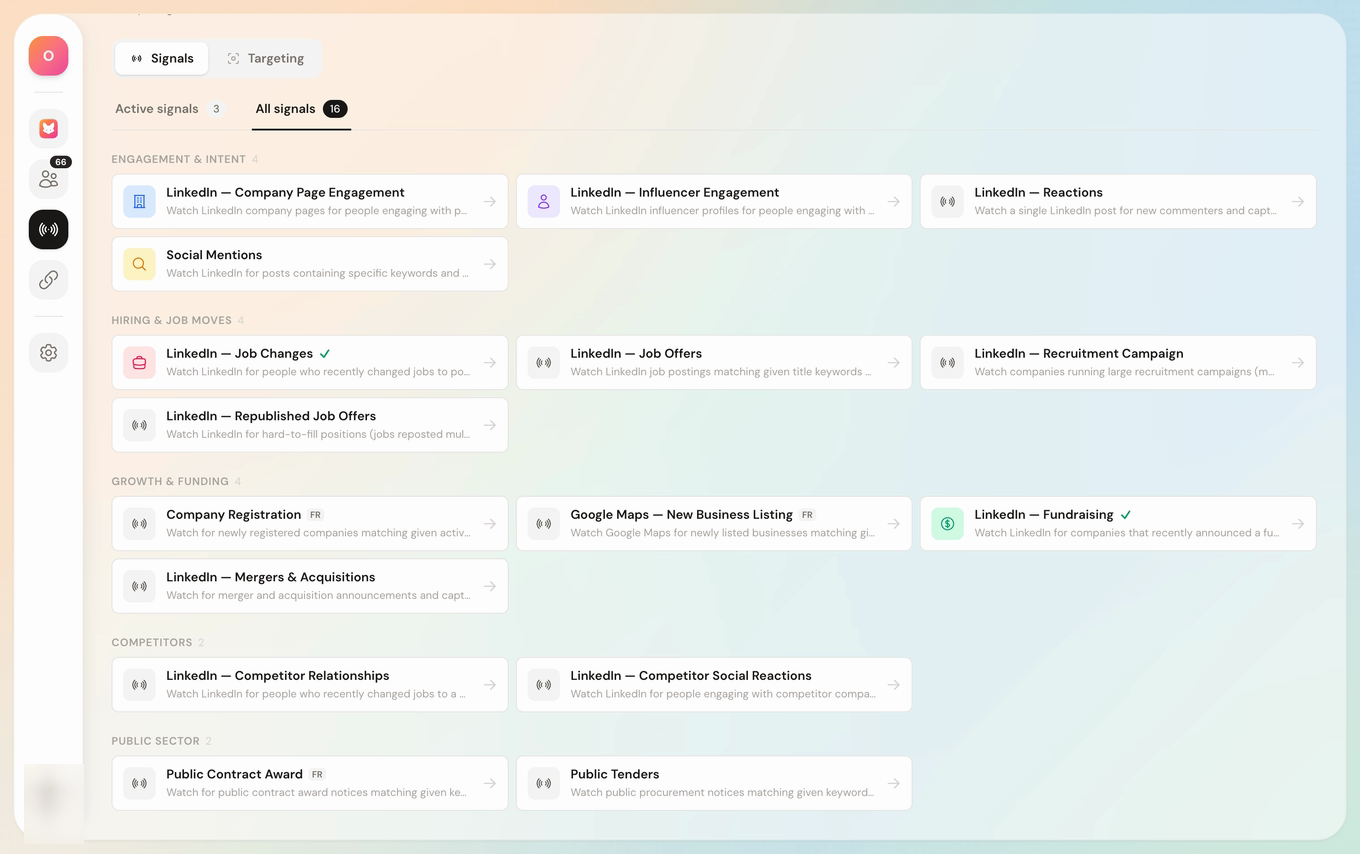
Max signal library grouped by engagement, hiring, growth, competitors and public-sector events
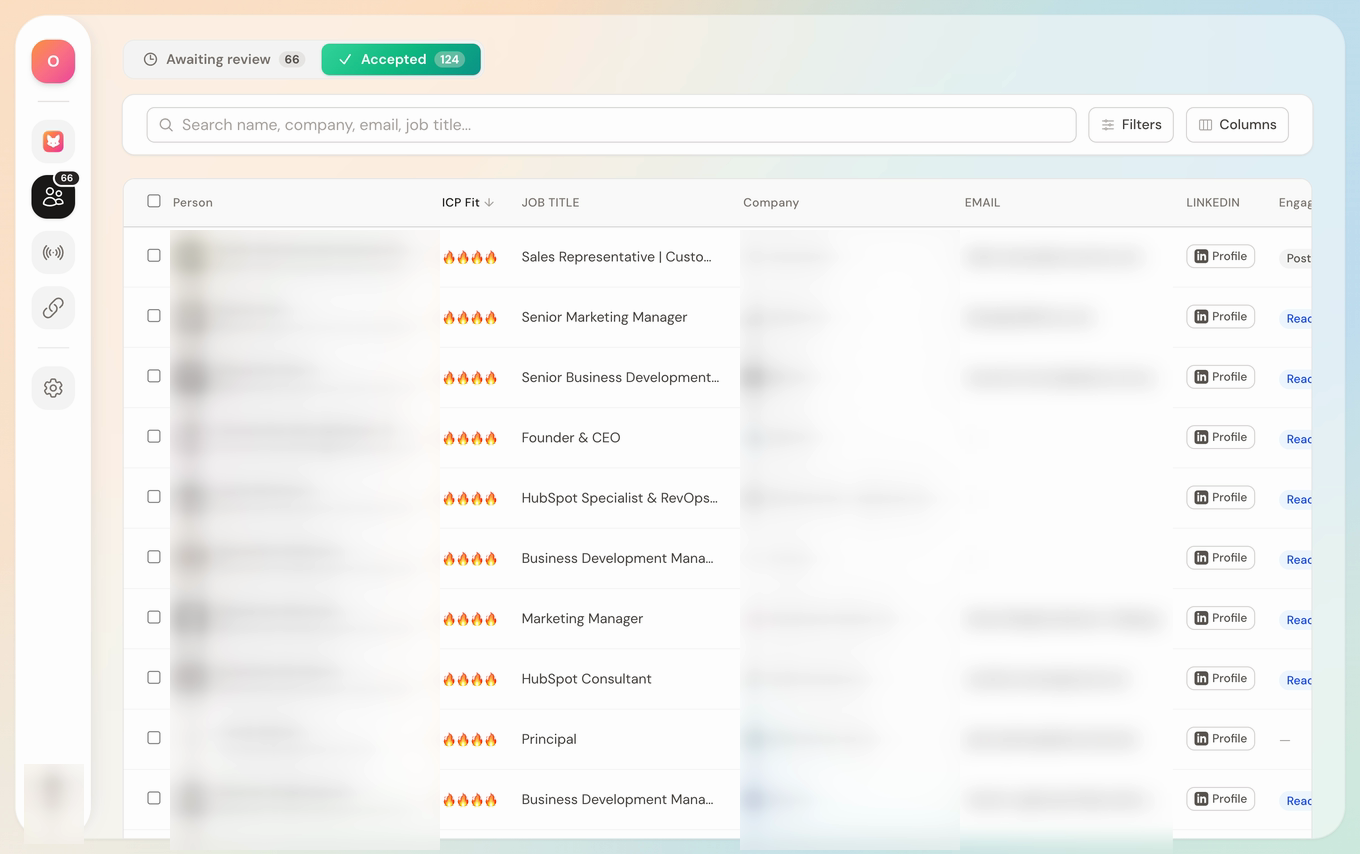
Accepted leadsAfter human review
Max accepted-leads queue after human review

From signal choice to reviewed output

The team chooses what to monitor, then accepts only the surfaced leads that clear its evidence and fit rules.

The actual Max product showing the signal library and the accepted-leads queue after human review.
What Max is showing hereIllustrative example
WatchlistHeld from today's list

How Max would operate the competitor mention outbound loop

Wait

Signal Max verified

For competitor mention outbound, Scout opens one case with this inspectable input: Public LinkedIn comment about a competitor.

Scout gathers public LinkedIn comment about a competitor, preserves the source, and exposes unresolved fields rather than completing them with guesses.

What Max refused to assume

For competitor mention outbound, Max does not assume that an available input deserves repetition, outreach, or scale. The team applies the field note rule instead: Use 0 for absent, 1 for unclear, and 2 for operational. Do not run the playbook when the input, accountable owner, evidence boundary, or stop condition is missing. Repeat only the part supported by the recorded buyer and commercial outcome.

Why it ranks here

For competitor mention outbound, the method is usable, but the current case does not yet clear the playbook's written decision rule. Max records what would change the status.

Decision trace: Strategist applies the playbook and records a Wait decision with its failed or passed gate.

Recommended next action

A dated watch record for competitor mention outbound, including the next evidence check and no outreach draft.

Closer prepares no draft while the account is in Wait.

Your rep stays in control

A named human reopens the evidence for competitor mention outbound, checks the inference, wording, permission, and suppression rules, then approves or rejects any external action.

Start tomorrow with the right leads.

Use Max to keep the competitor mention outbound decision inspectable while your team retains approval.

Start for free

Cancel anytime

Evidence desk

Research notes and sources

Sources were checked on . Each note states the limited point the source supports, so a benchmark is not mistaken for a promise.

How to read this bibliography

These references support the factual context and methods in this guide. They do not certify every sentence, validate a vendor's marketing claims, or imply that Max ran a hands-on product test. Vendor and industry research can still be useful, but its commercial incentives, sample, geography, and date should remain visible.

  1. Official guidanceUS Federal Trade Commission·Current policy page; accessed 2026-07-21

    Statement of Policy Regarding Comparative Advertising (opens in a new tab)

    What it supports
    The FTC's view that truthful, non-deceptive comparisons can inform buyers and that comparative claims should be clear and appropriately substantiated.
    Limit
    US policy statement, not approval of any comparison in this library and not a substitute for evidence supporting a named product claim.
  2. Official guidanceEuropean Commission·Directive 2006/114/EC; page accessed 2026-07-21

    Misleading and Comparative Advertising Directive (opens in a new tab)

    What it supports
    The EU framework for protecting traders from misleading B2B advertising and the conditions under which comparative advertising is permitted.
    Limit
    High-level EU framework, not legal advice. National implementation, facts, audience, and the exact comparison determine the analysis.

Methodology

How this brief was built.

Last material update
July 28, 2026. Dates change only when the article itself changes; a new year in the title is not treated as proof of freshness.
Recorded evidence boundary
Use public mentions, public reviews, public comments, public category context, CRM notes, or consent-safe first-party account signals only. Do not claim Max knows private buying intent, private competitor research, budget, urgency, or individual behavior. If a buyer directly shared information with your company, describe it as CRM context for human review, not as surveillance.
How it was built
This guide combines operator workflow steps, campaign packet requirements, human review points, and measurable conversion signals. The examples are teaching scenarios, not claims that a named prospect has private intent.
Limits
Benchmarks are directional, vendor facts can change, and no framework guarantees replies or revenue. Confirm material pricing, platform, legal, and compliance decisions at the primary source.

Questions

Questions buyers ask before acting.

What is competitor mention outbound?

It is a workflow for reviewing public or approved first-party competitor context, deciding whether it supports a relevant category question, and offering fair comparison help. The mention is not automatically evidence of intent, dissatisfaction, or an active evaluation.

Can I say I saw someone researching a competitor?

Only state an observation when the source, context, approved purpose, and wording all justify it. An account-level page event does not identify an individual, and a public comment does not reveal private research. When direct reference adds no useful context, lead with the category question instead.

How do I compare a competitor without attacking it?

Use buyer-defined criteria and run the same scenario for every candidate. Cite current official evidence, label unknowns, record trade-offs, and define the result that would rule each option out. Avoid unsupported superlatives, motive claims, and stale feature or pricing statements.

Where Max fits in competitor-mention outbound

After the team defines approved source types, evidence gates, comparison criteria, message boundaries, and stop rules, Max can help assemble records and prepare a draft for review. A human remains responsible for source context, fair representation, suppression, and the decision to contact.

Make tomorrow morning easier

Start with the right leads at the top of the list.

Use Max to keep the competitor mention outbound decision inspectable while your team retains approval.

Start for free

Cancel anytime