
How to build an ideal customer profile (ICP)

Nicolas Finet·Updated 12 min read

The answer in 60 seconds

What is an ideal customer profile (ICP)?

An ideal customer profile (ICP) is a description of the companies that get the most value from your product and return the most value to you. It is built from firmographics, the problem you solve, the buying committee, and evidence from your best existing customers. An ICP describes the company; a buyer persona describes the person inside it. The strongest ICPs are paired with buying signals so you contact the right accounts at the right time.

An ideal customer profile is the foundation of every outbound motion: get it wrong and every list, message, and signal downstream is aimed at the wrong companies. Demandbase's 2026 analysis of 1,452 tenants found companies tracking three to four buying groups had a 48.5% higher win rate than organizations taking a broader, less structured approach. That is an association, not proof that an ICP alone causes the lift. This guide shows how to build and test one.

Published . Last materially updated .

Source checkDemandbase Labs: State of ABM 2026 Benchmark Report

Open the primary source (opens in a new tab)

Supports
The relationship between defined and tracked buying groups, account-based execution, and reported win-rate performance.
Doesn’t prove
Vendor-published benchmark across 1,452 companies. Reported associations do not prove that buying-group tracking alone causes higher win rates.
Use this guideAn ICP is a testable account rule, not a buyer persona.Learning goals

Start with customer evidence

An ideal customer profile describes the kind of company your business can help well and serve profitably. It is built from account-level evidence; a buyer persona describes the people involved inside those accounts.

By the end, you will be able to draft an evidence-based ICP, write inclusion and exclusion rules, and define how the next cohort will test it.

After this guide, you can

  1. 01Distinguish an account profile from a buyer persona and a total addressable market.
  2. 02Turn customer evidence into explicit inclusion and exclusion rules.
  3. 03Validate the profile against retained, expanded, lost, and churned accounts.

Start with a short list of retained, expanded, lost, and churned customers; use the check below only after you have drafted the rules.

Step by step

How to build your ICP in five steps

  1. 01

    Start from your best customers

    List them by value and retention, not by your wish list.

  2. 02

    Find the shared pattern

    Extract the firmographics, problem, and buying committee they have in common.

  3. 03

    Write testable rules

    Turn the pattern into inclusion and exclusion rules a rep can apply in seconds.

  4. 04

    Validate against churn

    Confirm the rules also exclude your worst-fit, churned accounts.

  5. 05

    Pair with signals

    Layer buying signals so the ICP becomes a ranked, timely queue.

Why an ICP is worth the work

An ICP is an operating hypothesis, not a branding paragraph or a guaranteed growth lever. The sources below describe associations in particular buyer and account-based datasets; they do not isolate the causal effect of an ICP. Use them as reasons to test a narrower profile against your own wins, losses, retention, sales effort, and exclusions.

  • In Demandbase's 1,452-company benchmark, companies tracking three to four buying groups had a 48.5% higher win rate than organizations using a broader, less structured approach; this was an association, not proof of causation
  • About 95% of deals go to a vendor already on the buyer's Day-One shortlist (6sense, 2025)
  • Among TrustRadius technology buyers who formed a shortlist, 63% considered two or three products and 71% bought their first choice (TrustRadius, 2024)
  • Practical inference to test: a narrower ICP may concentrate effort on accounts where your evidence of fit is stronger

Evidence for named claims: Demandbase Labs · 6sense Research · TrustRadius

What an ICP actually is

An ideal customer profile describes the type of company that gets real value from your product and is profitable and durable for you to serve. It is about the account, not the individual. It should be specific enough that any rep can look at a company and say whether it fits or not, without a meeting.

  • Firmographics: industry, size, geography, business model
  • The problem your product solves for them
  • The buying committee and who owns the problem
  • Economic fit: ACV, retention, expansion potential

How to build one from real data

The reliable method starts from evidence, not opinion. List your best current customers by retention and value, find what they share, and write those patterns as rules. Then validate the rules against your worst-fit churned accounts to confirm the profile excludes them too.

  • Rank existing customers by value and retention
  • Find the shared firmographics and problems
  • Write the pattern as testable inclusion and exclusion rules
  • Validate against churned or low-fit accounts
  • Express it as a score, not a yes or no

The ICP template: fill this in

A useful ICP fits on one page and is specific enough that a rep can score any company against it without a meeting. Fill in each field from evidence in your best accounts, and write an exclusion for each inclusion so the profile actually rules companies out.

  • Industry and sub-vertical (include and exclude)
  • Company size: employees and revenue band
  • Geography and language
  • Business model: who they sell to and how they make money
  • The specific problem you solve and the trigger that surfaces it
  • Current tech stack or tools that signal fit
  • Economic fit: target ACV, expected retention, expansion potential
  • Buying committee: the owner, the champion, the blocker
  • Disqualifiers: the traits of your worst-fit churned accounts

A worked example (B2B SaaS)

This fictional mid-market sales-tooling example shows the specificity to aim for; none of its numbers are market benchmarks. The economic fields come from the fictional seller's own customer data. Committee roles are hypotheses to verify, not facts that external research can safely assume. Notice that the profile excludes as clearly as it includes.

  • Industry: B2B SaaS and tech-enabled services; exclude agencies and pure ecommerce
  • Size: 50 to 500 employees, $5M to $50M revenue
  • Geography: North America and Western Europe, English-speaking buyers
  • Problem: an outbound team scaling faster than its targeting can keep up
  • Stack signal: uses a CRM plus a sending tool but no decision layer
  • Internal cohort rule: $12K to $30K ACV and net revenue retention above 100%; not an externally observable prospect fact
  • Committee hypothesis: VP Sales may own the decision and RevOps may lead evaluation; verify roles and finance criteria rather than assuming a blocker
  • Disqualify: under 20 staff, no defined ICP, founder-only sales

ICP versus buyer persona

These are often confused. The ICP describes the company you want to win. The buyer persona describes the people inside that company you need to convince. You need both: the ICP decides which accounts to target, and the personas decide who to message and how. An ICP without personas produces account lists with no entry point; personas without an ICP produce well-written messages aimed at the wrong companies.

  • ICP: the company (firmographics, problem, economics)
  • Persona: the people (role, goals, objections)
  • ICP picks the account, persona picks the contact
  • Use both, in that order

The common mistakes

Most ICPs fail in predictable ways: they are aspirational rather than evidence-based, too broad to exclude anyone, or written once and never revisited. The fix is to treat the ICP as a living, testable model that tightens as win and loss data accumulates, and to pair it with signals so fit becomes timing.

  • Aspirational instead of evidence-based
  • Too broad to actually exclude accounts
  • Static, never updated with win or loss data
  • Fit without timing, so good accounts get contacted at the wrong moment

Bookmark this

The field note

The reusable model, scorecard, and exercise from this guide. Keep them in one place for your next pipeline review.

The mental model

  1. Outcomes01

    Start from good customers

    Use retention, expansion, value delivered, and cost to serve, not aspiration.

  2. Pattern02

    Find shared conditions

    Connect firmographics to a recurring problem and a workable buying process.

  3. Exclusions03

    Name the bad fit

    Rules become useful when they reject accounts that look attractive but repeatedly fail.

  4. Test04

    Predict the next cohort

    An ICP earns confidence by improving future decisions, not by explaining the past neatly.

The 10-point check

  1. Customer evidenceIs the profile built from retained and expanded customers rather than a wish list?0 · 1 · 2
  2. Problem patternDo the accounts share a costly problem and conditions under which your offer produces value?0 · 1 · 2
  3. EconomicsDo retention, expansion, acquisition effort, and cost to serve support this segment?0 · 1 · 2
  4. ExclusionsDo the rules reject recurring churn, implementation, budget, or buying-process mismatches?0 · 1 · 2
  5. UsabilityCan two teammates apply the rules to the same account and reach the same fit decision?0 · 1 · 2

Use 0 for unsupported, 1 for mixed, and 2 for well-supported. The total helps compare ICP drafts; it does not validate one. Do not operationalize a profile that lacks both positive customer evidence and explicit exclusions. Validate the surviving draft on the next account cohort.

Worked gate check

Evidence set
Ten retained or expanded customers, five lost deals, and five churned accounts.
Candidate rule
A narrow account pattern linked to a recurring costly problem and viable buying process.
Exclusion
Accounts that match the firmographics but repeatedly fail implementation or economics.
Next test
Two teammates classify the next 20 accounts independently, then compare decisions and outcomes.

20-minute practice

Try it on one account today.

The point is not to automate faster. It is to learn whether the reasoning survives contact with a real account.

  1. 1List retained and expanded customers alongside lost and churned accounts.
  2. 2Write three inclusion rules and three exclusion rules from the differences you can support.
  3. 3Ask a teammate to classify the same ten accounts without seeing your answers.
  4. 4Resolve disagreements, then define the next cohort and outcome that will test the revised profile.
Plain-English glossary
Ideal customer profile
A testable description of the account type your business can help well and serve profitably.
Buyer persona
A description of a person, role, goals, and concerns inside a target account.
Inclusion rule
Evidence that makes an account more likely to fit the profile.
Exclusion rule
A supported condition that disqualifies an otherwise attractive-looking account.
Validation cohort
New accounts used to test whether the ICP improves decisions beyond the historical sample that created it.
Plain-text field note+

See Max at work

Your best leads, delivered every morning.

Max watches buying signals continuously and ranks who's most likely to convert, so your team knows exactly who to contact first and why.

Actual Max interface

Product captures
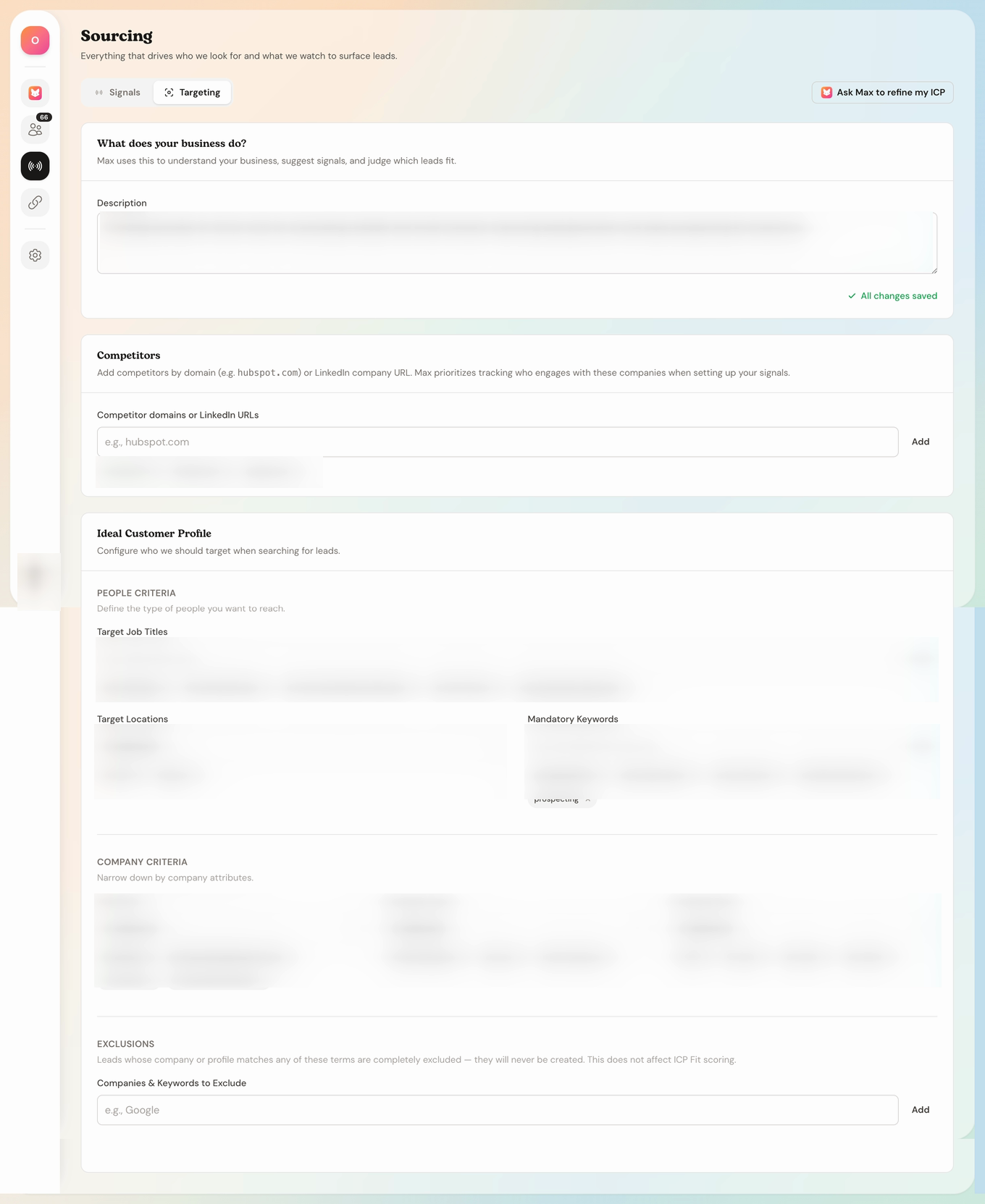
Max targeting screen with business, competitor, people and company criteria

Targeting before sourcing

Define the business, competitors, people, company criteria and exclusions Max should use before it ranks a lead.

The actual Max targeting screen with the business description, competitors, people criteria, company criteria and exclusions.
What Max is showing hereIllustrative example
ExcludedRemoved from today's list

How Max would use an ICP to say no

Stop

Signal Max verified

Scout compares one illustrative account with explicit inclusion and exclusion rules derived from retained, expanded, lost, and churned customer evidence.

Scout applies the same inclusion and exclusion rules to the account and records which customer evidence supports each answer.

What Max refused to assume

Max does not treat company size, funding, or a prestigious logo as sufficient fit. A visible signal cannot repair a recurring implementation, retention, or cost-to-serve mismatch.

Why it ranks here

The illustrative account matches the headline firmographics but triggers a written exclusion rule. Strategist protects the team's time instead of widening the ICP after seeing an attractive name.

Decision trace: Strategist assigns Stop because one proven exclusion outweighs superficial fit.

Recommended next action

A stopped-account record naming the exclusion, evidence used, accountable reviewer, and next cohort review date. No outreach draft is created.

Closer prepares no draft for an account outside the approved ICP.

Your rep stays in control

A named human reopens the evidence for ideal customer profile, checks the inference, wording, permission, and suppression rules, then approves or rejects any external action.

Start tomorrow with the right leads.

Use Max to turn the ICP from a slide into an auditable account-level yes or no.

Start for free

Cancel anytime

Evidence desk

Research notes and sources

Sources were checked on . Each note states the limited point the source supports, so a benchmark is not mistaken for a promise.

How to read this bibliography

These references support the factual context and methods in this guide. They do not certify every sentence, validate a vendor's marketing claims, or imply that Max ran a hands-on product test. Vendor and industry research can still be useful, but its commercial incentives, sample, geography, and date should remain visible.

  1. Original researchDemandbase Labs·2026

    State of ABM 2026 Benchmark Report (opens in a new tab)

    What it supports
    The relationship between defined and tracked buying groups, account-based execution, and reported win-rate performance.
    Limit
    Vendor-published benchmark across 1,452 companies. Reported associations do not prove that buying-group tracking alone causes higher win rates.
  2. Original research6sense Research·2025

    2025 B2B Buyer Experience Report (opens in a new tab)

    What it supports
    Buyer-journey context used in this guide: Day-One shortlists, the timing of first seller contact, and the advantage held by the pre-contact favorite.
    Limit
    Vendor-produced research based on a global survey of nearly 4,000 B2B buyers. It describes aggregate behavior, not the outcome of any single deal.
  3. Original researchTrustRadius·June 10, 2024

    2024 B2B Buying Disconnect Report (opens in a new tab)

    What it supports
    Software-buyer shortlist size, preference for familiar vendors, research sources, buying-group composition, and the role of demos, trials, and peer evidence.
    Limit
    Survey of 2,164 technology buyers and 243 technology vendors from the TrustRadius network; findings are strongest for B2B technology purchases.

Methodology

How this brief was built.

Last material update
July 21, 2026. Dates change only when the article itself changes; a new year in the title is not treated as proof of freshness.
How it was built
This guide combines operator workflow steps, campaign packet requirements, human review points, and measurable conversion signals. The examples are teaching scenarios, not claims that a named prospect has private intent.
Limits
Benchmarks are directional, vendor facts can change, and no framework guarantees replies or revenue. Confirm material pricing, platform, legal, and compliance decisions at the primary source.

Questions

Questions buyers ask before acting.

What is an ideal customer profile?

An ideal customer profile (ICP) is a description of the companies that get the most value from your product and are most profitable for you to serve. It is built from firmographics, the problem you solve, the buying committee, and evidence from your best customers.

What is the difference between an ICP and a buyer persona?

An ICP describes the company you want to win; a buyer persona describes the people inside it you need to convince. The ICP decides which accounts to target, and the personas decide who to contact and how.

How does Max use an ICP?

Max turns your ICP into testable best-fit rules, scores accounts against them, then layers buying signals so the ICP becomes a ranked, timely queue rather than a static description. It also sharpens the profile as outcomes come in.

Make tomorrow morning easier

Start with the right leads at the top of the list.

Use Max to turn the ICP from a slide into an auditable account-level yes or no.

Start for free

Cancel anytime