
Hiring signal outbound: turn job posts into useful sales timing

Nicolas Finet·Updated 12 min read

The answer in 60 seconds

How should you run this workflow without turning it into generic outbound?

Hiring-signal outbound is a method for collecting current job posts, extracting their stated responsibilities, testing whether those responsibilities relate to your offer, and sending a question-led message only after a human reviews the evidence. Treat every business implication as a hypothesis until the company confirms it.

A public job posting describes work a company wants someone to perform. It can help a seller form a question about team capacity, process, geography, or skills, but it does not reveal an approved project, available budget, or vendor search. The useful discipline is to preserve that boundary from research through outreach.

Published . Last materially updated .

Source checkU.S. Bureau of Labor Statistics: Job Openings and Labor Turnover Survey: Data Definitions

Open the primary source (opens in a new tab)

Supports
One useful operational definition, used by the U.S. JOLTS survey, requires a specific position, available work, a start within 30 days, and active external recruiting.
Doesn’t prove
JOLTS is an establishment survey and an aggregate labor-demand measure. Its definition does not reveal why one company opened a role, whether it is net-new, or whether a vendor budget exists.
Use this guideTurn the workflow into a small, reviewable experiment.Learning goals

Start with the decision

A playbook is a repeatable way to make one commercial decision. Define the input and owner, run one small test, and inspect the result before repeating it.

By the end, you will be able to run this workflow manually on one account, review the output, and decide what, if anything, deserves repetition.

After this guide, you can

  1. 01Define the input, owner, and decision before adding automation.
  2. 02Apply this playbook to this case: Several related roles open in the same team.
  3. 03Review evidence, wording, and outcome so the next run gets smarter.

The exercise keeps the first run manual so the team can inspect the reasoning before it repeats the workflow.

1. Start with a role-to-work hypothesis

Choose one role family and write the specific work it may own before collecting postings. For example, implementation hiring may relate to onboarding capacity, while a revenue operations role may relate to definitions, routing, or reporting. These are research hypotheses, not facts about every company. If your offer cannot help examine a stated responsibility, the job title alone is not relevant.

  • Define the target account and clear disqualifiers
  • List the job titles and responsibility phrases that qualify for review
  • Name one practical question your expertise can help answer
  • Prepare exclusions, routing rules, approved sources, and a reviewer

2. Capture the posting so another person can verify it

Save the source URL, capture date, company, exact title, location, job identifier where available, and the responsibility sentence that triggered review. Note whether the listing appears on the company's own careers site and whether similar records may be duplicates. A removed, reposted, or undated vacancy needs re-verification; it should not silently remain active in a campaign queue.

  • Observed fact: quote or paraphrase only what the posting states
  • Source status: current, removed, duplicated, ambiguous, or awaiting review
  • Account context: fit, CRM owner, existing conversation, and exclusions
  • Unknowns: headcount plan, urgency, budget, reporting line, and vendor interest

3. Translate responsibilities without inventing pain

Use a three-column note: what the advert says, what operational question it could raise, and what remains unknown. 'Own onboarding for enterprise customers' is evidence. 'The company may be reviewing onboarding capacity' is a hypothesis. 'They need our implementation service now' is an unsupported conclusion. This translation step is where a sales manager should challenge whether the proposed help truly follows from the text.

  • Copy the responsibility phrase that matters
  • Phrase the operational implication with conditional language
  • Name the likely functional owner, then verify that person's remit
  • Write the assumptions the message must never present as known facts

4. Look for a coherent pattern, not a bigger number

Several postings deserve to be grouped only when they point to the same work question. Three unrelated vacancies do not form a meaningful hiring pattern. Review team, location, responsibilities, publication timing, and duplicate identifiers. Also distinguish permanent recruitment pages from newly published roles. The purpose of clustering is to understand the stated work, not to manufacture a stronger intent label.

  • Same team and related responsibilities: review as one work hypothesis
  • Same title on multiple boards: deduplicate before counting
  • Different functions or locations: keep separate until a public link is clear
  • Evergreen or stale listings: exclude or mark explicitly for manual review

5. Use hard gates before prioritization

Make the record eligible only if the source is current enough for your policy, the account fits, the stated work connects to your expertise, an appropriate owner can be identified, and contact is permitted. Rank eligible records by your team's capacity afterward. A high count of postings must not override a failed evidence, fit, ownership, or suppression gate.

  • Evidence gate: live source and reproducible responsibility phrase
  • Relevance gate: a direct connection to one defined work question
  • Usefulness gate: a concrete diagnostic or example to offer
  • Safety gate: owner, channel, suppression, and wording approved

6. Write a message that invites correction

Example: 'Northstar is advertising two implementation roles that both mention enterprise onboarding. That may simply be planned capacity. One useful handoff check is whether every intake records the owner, required customer input, due date, blocker, and acceptance rule. Which field causes the most rework for you, or is onboarding standardization unrelated to the hiring?' The message cites the public work, labels the inference, gives away the diagnostic, and makes correction easy.

  • Reference the responsibility or coherent pattern, not a secret initiative
  • Use one conditional implication rather than a chain of assumptions
  • Ask about the work before proposing a product or meeting
  • Never contact an applicant or reveal unnecessary personal information

7. Review outcomes and define when to stop

Test with a batch small enough to inspect source quality, drafts, and replies individually. Track records found, duplicates removed, records rejected by each gate, meaningful replies, corrections, opt-outs, complaints, qualified next steps, and opportunities. Pause immediately for a factual error, suppression failure, or privacy complaint. Rework or retire a role hypothesis when recipients repeatedly say the proposed work question is irrelevant; do not answer weak learning by expanding the title list.

  • Research quality: live-source rate, duplicates, and interpretation corrections
  • Message quality: reviewer rejection and substantive reply themes
  • Commercial outcome: qualified progression, measured separately from replies
  • Safety: opt-outs, complaints, and any use of a prohibited source or phrase

Bookmark this

The field note

The reusable model, scorecard, and exercise from this guide. Keep them in one place for your next pipeline review.

The mental model

  1. Input01

    A dated role pattern from the employer's careers site

    Keep the source, permission, and unresolved unknowns visible.

  2. Decision02

    Research, contact, or reject the hiring hypothesis

    Write the choice and accountable owner before drafting or automating.

  3. Output03

    A role-to-work brief plus one readiness check

    Make the artifact inspectable and usable by a second operator.

  4. Review04

    Verified patterns, false positives, and replies by hiring route

    Repeat only when the observed outcome supports the rule.

The 10-point check

  1. InputIs this input complete, permitted, and inspectable: A dated role pattern from the employer's careers site?0 · 1 · 2
  2. DecisionIs one named owner accountable for this choice: Research, contact, or reject the hiring hypothesis?0 · 1 · 2
  3. OutputDoes the run produce this usable artifact: A role-to-work brief plus one readiness check?0 · 1 · 2
  4. BoundaryAre evidence limits, exclusions, permissions, and stop conditions explicit?0 · 1 · 2
  5. LearningWill the review keep verified patterns, false positives, and replies by hiring route tied to this run?0 · 1 · 2

Use 0 for absent, 1 for unclear, and 2 for operational. Do not run the playbook when the input, accountable owner, evidence boundary, or stop condition is missing. Repeat only the part supported by the recorded buyer and commercial outcome.

Worked gate check

Input to verify
A dated role pattern from the employer's careers site
Decision to record
Research, contact, or reject the hiring hypothesis
Smallest useful output
A role-to-work brief plus one readiness check
Evidence for the next review
Verified patterns, false positives, and replies by hiring route

20-minute practice

Try it on one account today.

The point is not to automate faster. It is to learn whether the reasoning survives contact with a real account.

  1. 1Choose one real account and assemble only this input: A dated role pattern from the employer's careers site.
  2. 2Write the decision before drafting: Research, contact, or reject the hiring hypothesis.
  3. 3Build exactly one reviewable output: A role-to-work brief plus one readiness check.
  4. 4Ask a second operator to challenge the source, permission, evidence boundary, exclusions, and stop condition.
  5. 5Record verified patterns, false positives, and replies by hiring route. Repeat only the rule that the evidence supports.
Plain-English glossary
Hiring signal outbound
The specific operating playbook covered here, bounded to one input, decision, owner, and reviewable output.
Decision owner
The person accountable for the action, exceptions, and review boundary.
Reversible test
A small trial that can stop without committing a large list, budget, or customer relationship.
Campaign asset
A useful object that reduces the recipient's work or uncertainty.
Learning loop
A review of evidence, decisions, outcomes, and corrections before the workflow repeats.
Plain-text field note+

See Max at work

Your best leads, delivered every morning.

Max watches buying signals continuously and ranks who's most likely to convert, so your team knows exactly who to contact first and why.

Actual Max interface

Product captures
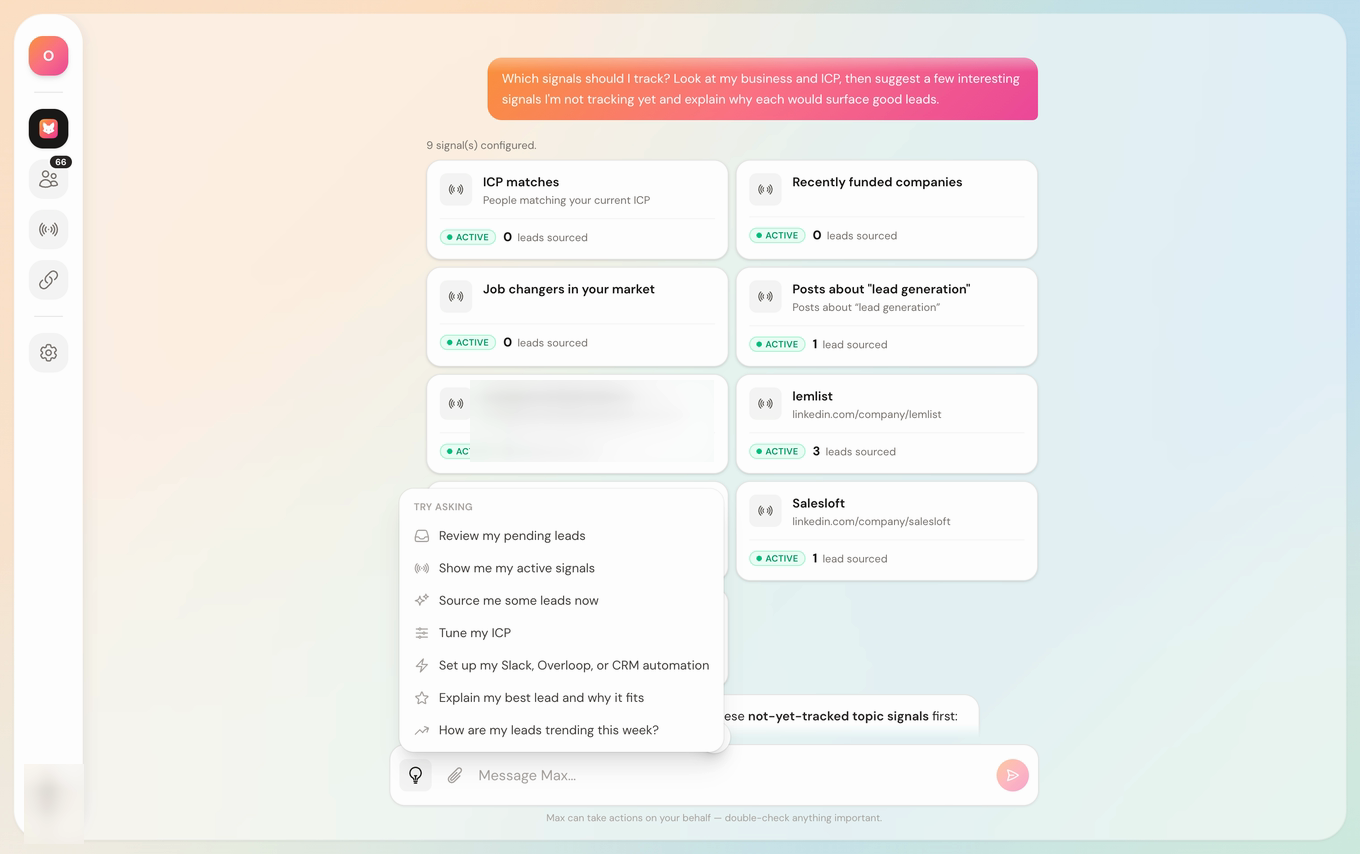

Max workspace showing active job-change, funding, topic and competitor signals
Accepted leadsAfter human review
Max accepted-leads queue after human review

From monitored signal to accepted lead

The signal stays visible upstream; a human still decides which surfaced leads move into the accepted queue.

The actual Max product showing active signals and the accepted-leads queue after human review.
What Max is showing hereIllustrative example
Research queueOne more signal needed

How Max would operate the hiring signal outbound loop

Research

Signal Max verified

For hiring signal outbound, Scout opens one case with this inspectable input: Several related roles open in the same team.

Scout gathers several related roles open in the same team, preserves the source, and exposes unresolved fields rather than completing them with guesses.

What Max refused to assume

For hiring signal outbound, Max does not assume that an available input deserves repetition, outreach, or scale. The team applies the field note rule instead: Use 0 for absent, 1 for unclear, and 2 for operational. Do not run the playbook when the input, accountable owner, evidence boundary, or stop condition is missing. Repeat only the part supported by the recorded buyer and commercial outcome.

Why it ranks here

For hiring signal outbound, the workflow can organize the case, but the source, account fit, or decision owner still needs verification before a message is useful.

Decision trace: Strategist applies the playbook and records a Research decision with its failed or passed gate.

Recommended next action

A research card for hiring signal outbound, with the missing evidence named and no outreach draft.

Closer prepares no draft while the account is in Research.

Your rep stays in control

A named human reopens the evidence for hiring signal outbound, checks the inference, wording, permission, and suppression rules, then approves or rejects any external action.

Start tomorrow with the right leads.

Use Max to keep the hiring signal outbound decision inspectable while your team retains approval.

Start for free

Cancel anytime

Evidence desk

Research notes and sources

Sources were checked on . Each note states the limited point the source supports, so a benchmark is not mistaken for a promise.

How to read this bibliography

These references support the factual context and methods in this guide. They do not certify every sentence, validate a vendor's marketing claims, or imply that Max ran a hands-on product test. Vendor and industry research can still be useful, but its commercial incentives, sample, geography, and date should remain visible.

  1. Official guidanceU.S. Bureau of Labor Statistics·Live definition; updated May 6, 2026; accessed 2026-07-21

    Job Openings and Labor Turnover Survey: Data Definitions (opens in a new tab)

    What it supports
    One useful operational definition, used by the U.S. JOLTS survey, requires a specific position, available work, a start within 30 days, and active external recruiting.
    Limit
    JOLTS is an establishment survey and an aggregate labor-demand measure. Its definition does not reveal why one company opened a role, whether it is net-new, or whether a vendor budget exists.
  2. Official guidanceUK Office for National Statistics·Methodology revised November 5, 2024; accessed 2026-07-21

    Measuring Labour Demand Volumes Across the UK Using Textkernel Data (opens in a new tab)

    What it supports
    Job adverts expose titles, descriptions, posting dates, expiry dates, locations, and skills, while duplicate removal is necessary before interpreting volume.
    Limit
    ONS explicitly distinguishes an online advert from a vacancy. One advert may cover several posts, duplicates are common, coverage is incomplete, and a live advert does not establish a company's commercial motive.
  3. Official guidanceEurostat·Live methodology; accessed 2026-07-21

    Online Job Advertisement Rate: Experimental Statistics (opens in a new tab)

    What it supports
    Online job advertisements can provide detailed, timely evidence about positions, named skills, contract characteristics, location, and employer activity.
    Limit
    The dataset is experimental, portal coverage is not exhaustive, occupation and sector coverage is biased, and model classifications may contain errors. It cannot establish budget or purchase intent.

Methodology

How this brief was built.

Last material update
July 28, 2026. Dates change only when the article itself changes; a new year in the title is not treated as proof of freshness.
Recorded evidence boundary
Use public job postings, public careers pages, public company context, and approved first-party account history only. Do not imply private hiring plans, hidden budget, internal pain, vendor evaluation, or confirmed buying intent unless the company has stated it publicly.
How it was built
This guide combines operator workflow steps, campaign packet requirements, human review points, and measurable conversion signals. The examples are teaching scenarios, not claims that a named prospect has private intent.
Limits
Benchmarks are directional, vendor facts can change, and no framework guarantees replies or revenue. Confirm material pricing, platform, legal, and compliance decisions at the primary source.

Questions

Questions buyers ask before acting.

Why are job postings useful for outbound sales?

They provide public, attributable descriptions of work a company wants performed. That can support a relevant question, but the posting does not prove budget for your category, urgency, pain, or a vendor evaluation.

How many open roles make a hiring signal meaningful?

There is no universal count. One detailed role can support a useful question; several unrelated or duplicated listings may add nothing. Judge whether the responsibilities form a coherent, verifiable work hypothesis and whether the account passes the other gates.

What should happen when a job posting disappears?

Mark the source as removed and re-verify the underlying fact before contact. Do not infer that the role was filled, cancelled, or paused unless the company states that. Remove the record from automated queues while its status is unclear.

Where Max fits in a hiring-signal workflow

Once the team has defined approved sources, role hypotheses, hard gates, ownership, and stop rules, Max can help collect evidence and prepare a brief and draft. A human still verifies the posting, approves the interpretation, checks suppression rules, and decides whether the message should be sent.

Make tomorrow morning easier

Start with the right leads at the top of the list.

Use Max to keep the hiring signal outbound decision inspectable while your team retains approval.

Start for free

Cancel anytime