
The intent-led lead generation playbook

Nicolas Finet·Updated 11 min read

The answer in 60 seconds

How should you run this workflow without turning it into generic outbound?

Intent-led lead generation combines account fit with recent, permission-safe evidence of change, then maps that evidence to a problem owner, a helpful asset, and a human-reviewed message. The signal determines what to investigate; it never proves that the buyer intends to purchase.

Intent-led lead generation starts with two separate questions: is this a company you can serve well, and is there visible evidence that a relevant decision may be easier to discuss now? The method is not a licence to track everything. It is a disciplined way for a small commercial team to replace a flat prospect list with an evidence-based queue and a useful next step.

Published . Last materially updated .

Source checkEuropean Data Protection Board: Legal Basis

Open the primary source (opens in a new tab)

Supports
The requirement to identify a GDPR legal basis before processing personal data and the added constraints around sensitive categories.
Doesn’t prove
High-level EU guidance, not legal advice or a blanket authorization for direct marketing, tracking, enrichment, or outreach in any jurisdiction.
Use this guideTurn the workflow into a small, reviewable experiment.Learning goals

Start with the decision

A playbook is a repeatable way to make one commercial decision. Define the input and owner, run one small test, and inspect the result before repeating it.

By the end, you will be able to run this workflow manually on one account, review the output, and decide what, if anything, deserves repetition.

After this guide, you can

  1. 01Define the input, owner, and decision before adding automation.
  2. 02Apply this playbook to this case: Job change.
  3. 03Review evidence, wording, and outcome so the next run gets smarter.

The exercise keeps the first run manual so the team can inspect the reasoning before it repeats the workflow.

1. Understand fit, timing, and evidence

A strong account and a timely account are not the same thing. Fit describes whether the company can benefit from your offer and be served profitably. A signal describes a recent event or behavior that may change the timing. Evidence is the public or approved first-party fact behind that signal. Keep all three visible so a seller can challenge the interpretation before acting.

  • Fit: industry, size, geography, problem, economics, and disqualifiers
  • Signal: the recent event or behavior worth investigating
  • Evidence: source, date, observable fact, and permission status
  • Interpretation: the buyer situation you believe may follow
  • Action: owner, asset, message, approval status, and result

2. Recognize the signals worth starting with

Choose signals that are visible, current, explainable to a salesperson, and directly connected to work your offer supports. Public company changes such as a relevant hire, team buildout, launch, or migration are usually easier to reason about than anonymous topic scores. Start with a small set so the team can learn what each signal actually predicts instead of mixing every source into one opaque score.

  • Choose signals with an obvious connection to the problem you solve
  • Prefer sources a human can inspect and explain
  • Define the common false positive before collecting the data
  • Exclude sensitive, private, ambiguous, or permission-unclear evidence
  • Do not use a weak signal unless fit and stronger context support it

3. Apply the fit-and-timing test to a small account

Imagine a hypothetical small IT services firm selling cloud-migration help to regional manufacturers. Its best-fit account has an aging on-premise stack and a small internal IT team. The firm sees a target manufacturer hire its first cloud lead and publish infrastructure roles. The public facts justify researching a migration-readiness problem. They do not prove a project or budget. The firm offers a readiness checklist to the IT director instead of pitching a migration engagement immediately.

  • Fit: regional manufacturer, relevant infrastructure, serviceable geography
  • Evidence: public cloud-lead appointment and related technical hiring
  • Hypothesis: the team may be preparing for cloud operating changes
  • False positive: routine replacement hiring with no actual migration plan
  • Safe action: offer a readiness checklist and let the buyer confirm relevance

4. Score accounts with a visible decision sheet

Avoid a mystery intent score. Give each account a green, amber, or red status across six questions: does the company fit, is the source allowed and reliable, is the signal recent, does it connect to a problem you solve, is the likely owner clear, and can the message be useful without overclaiming? Record the reason for every status. Green enters human review, amber waits for research, and red is suppressed.

  • Account fit independent of the signal
  • Source permission and reliability
  • Signal recency and strength
  • Problem relevance and owner clarity
  • Evidence boundary and message safety
  • A specific useful next step

5. Build the signal-to-campaign map

For every approved signal, fill in one row before writing copy: observable event, likely business situation, problem owner, evidence boundary, useful asset, first-touch angle, next step, and success measure. If the team cannot complete the row without guessing, the account is not ready. This map is the reusable operating asset; the email is only one output from it.

  • Event: what changed and where the evidence lives
  • Situation: what the event may mean, written as a hypothesis
  • Owner: the role likely to care, not the person presumed to have triggered the signal
  • Asset: checklist, teardown, benchmark, comparison, or plan matched to the situation
  • Outcome: the buyer action and commercial result you will record

6. Use a low-friction first-touch structure

Use this structure: 'Hi [name], [public company change] can create a decision around [business problem]. A useful first check is [complete step from the asset] because it distinguishes [case A] from [case B]. Which case matches how [company] works today?' Keep the implication conditional, omit claims about private intent, and give useful content before any request for time. A human should review the evidence and wording before contact.

  • One public fact, not a stack of tracked behaviors
  • One plausible business implication, clearly framed as a pattern
  • One asset that answers a real buyer question
  • One low-friction next step
  • One explicit review and suppression decision

7. Measure the learning loop

Report by signal, segment, owner, message angle, and asset. Track accounts reviewed, accounts approved, replies, useful conversations, resource requests, meetings, qualified opportunities, pipeline, opt-outs, complaints, and false positives. Review why amber and red accounts were rejected too. That evidence tells you which signals deserve investment and which merely generate impressive-looking activity.

  • Quality: approval rate, positive replies, and useful conversations
  • Multi-signal outcomes: meetings, qualified opportunities, and pipeline
  • Buyer value: resource requests and progression to a relevant next step
  • Safety: opt-outs, complaints, and drafts rejected in review
  • Signal health: false positives and results by source and account segment

Bookmark this

The field note

The reusable model, scorecard, and exercise from this guide. Keep them in one place for your next pipeline review.

The mental model

  1. Input01

    One best-fit account plus one permitted timing clue

    Keep the source, permission, and unresolved unknowns visible.

  2. Decision02

    Research, act, wait, or stop

    Write the choice and accountable owner before drafting or automating.

  3. Output03

    A fit-and-timing decision sheet

    Make the artifact inspectable and usable by a second operator.

  4. Review04

    Buyer and pipeline outcomes split by signal and segment

    Repeat only when the observed outcome supports the rule.

The 10-point check

  1. InputIs this input complete, permitted, and inspectable: One best-fit account plus one permitted timing clue?0 · 1 · 2
  2. DecisionIs one named owner accountable for this choice: Research, act, wait, or stop?0 · 1 · 2
  3. OutputDoes the run produce this usable artifact: A fit-and-timing decision sheet?0 · 1 · 2
  4. BoundaryAre evidence limits, exclusions, permissions, and stop conditions explicit?0 · 1 · 2
  5. LearningWill the review keep buyer and pipeline outcomes split by signal and segment tied to this run?0 · 1 · 2

Use 0 for absent, 1 for unclear, and 2 for operational. Do not run the playbook when the input, accountable owner, evidence boundary, or stop condition is missing. Repeat only the part supported by the recorded buyer and commercial outcome.

Worked gate check

Input to verify
One best-fit account plus one permitted timing clue
Decision to record
Research, act, wait, or stop
Smallest useful output
A fit-and-timing decision sheet
Evidence for the next review
Buyer and pipeline outcomes split by signal and segment

20-minute practice

Try it on one account today.

The point is not to automate faster. It is to learn whether the reasoning survives contact with a real account.

  1. 1Choose one real account and assemble only this input: One best-fit account plus one permitted timing clue.
  2. 2Write the decision before drafting: Research, act, wait, or stop.
  3. 3Build exactly one reviewable output: A fit-and-timing decision sheet.
  4. 4Ask a second operator to challenge the source, permission, evidence boundary, exclusions, and stop condition.
  5. 5Record buyer and pipeline outcomes split by signal and segment. Repeat only the rule that the evidence supports.
Plain-English glossary
Intent-led lead generation
The specific operating playbook covered here, bounded to one input, decision, owner, and reviewable output.
Decision owner
The person accountable for the action, exceptions, and review boundary.
Reversible test
A small trial that can stop without committing a large list, budget, or customer relationship.
Campaign asset
A useful object that reduces the recipient's work or uncertainty.
Learning loop
A review of evidence, decisions, outcomes, and corrections before the workflow repeats.
Plain-text field note+

See Max at work

Your best leads, delivered every morning.

Max watches buying signals continuously and ranks who's most likely to convert, so your team knows exactly who to contact first and why.

Actual Max interface

Product captures
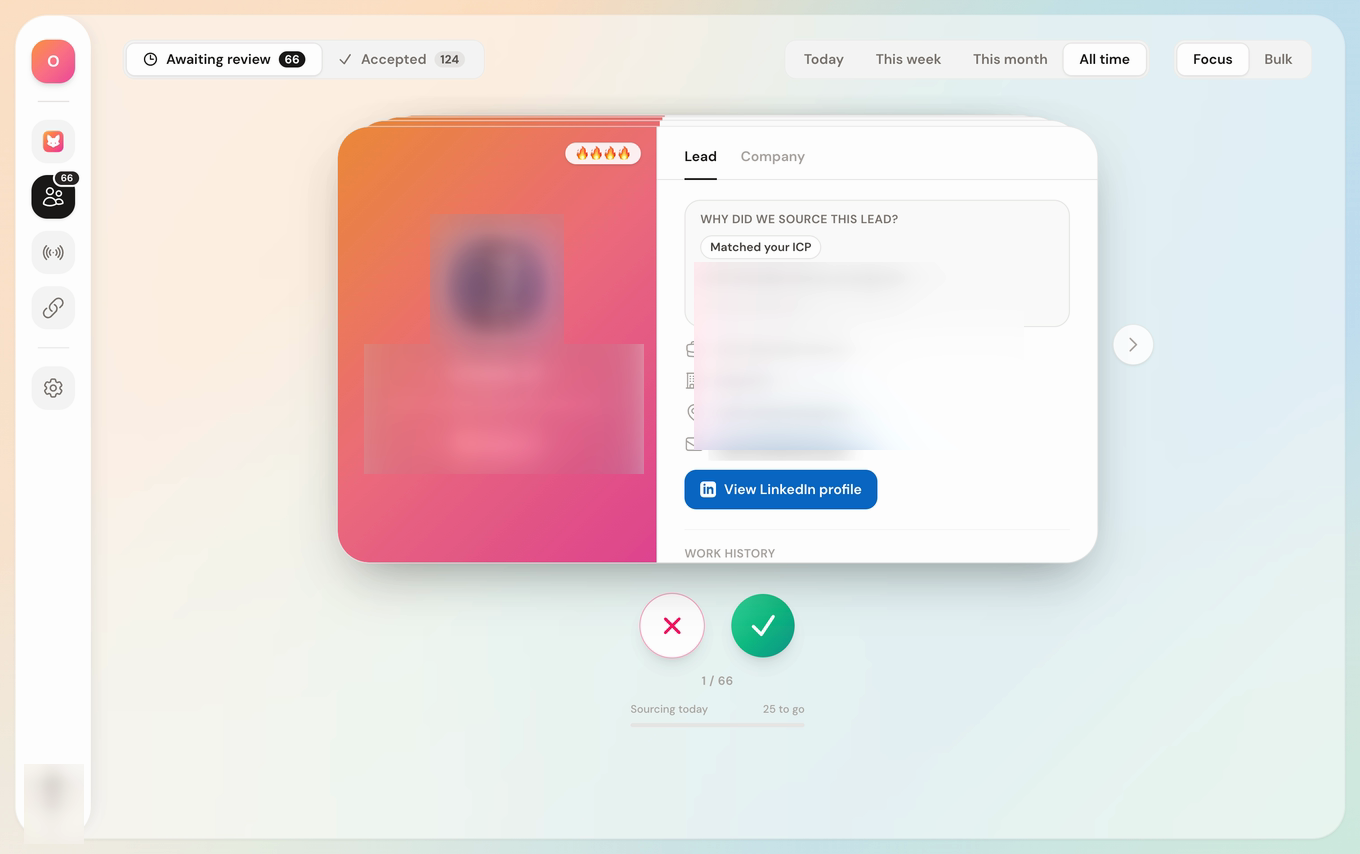
Max lead detail showing why a prospect was sourced
Morning queueRanked for review
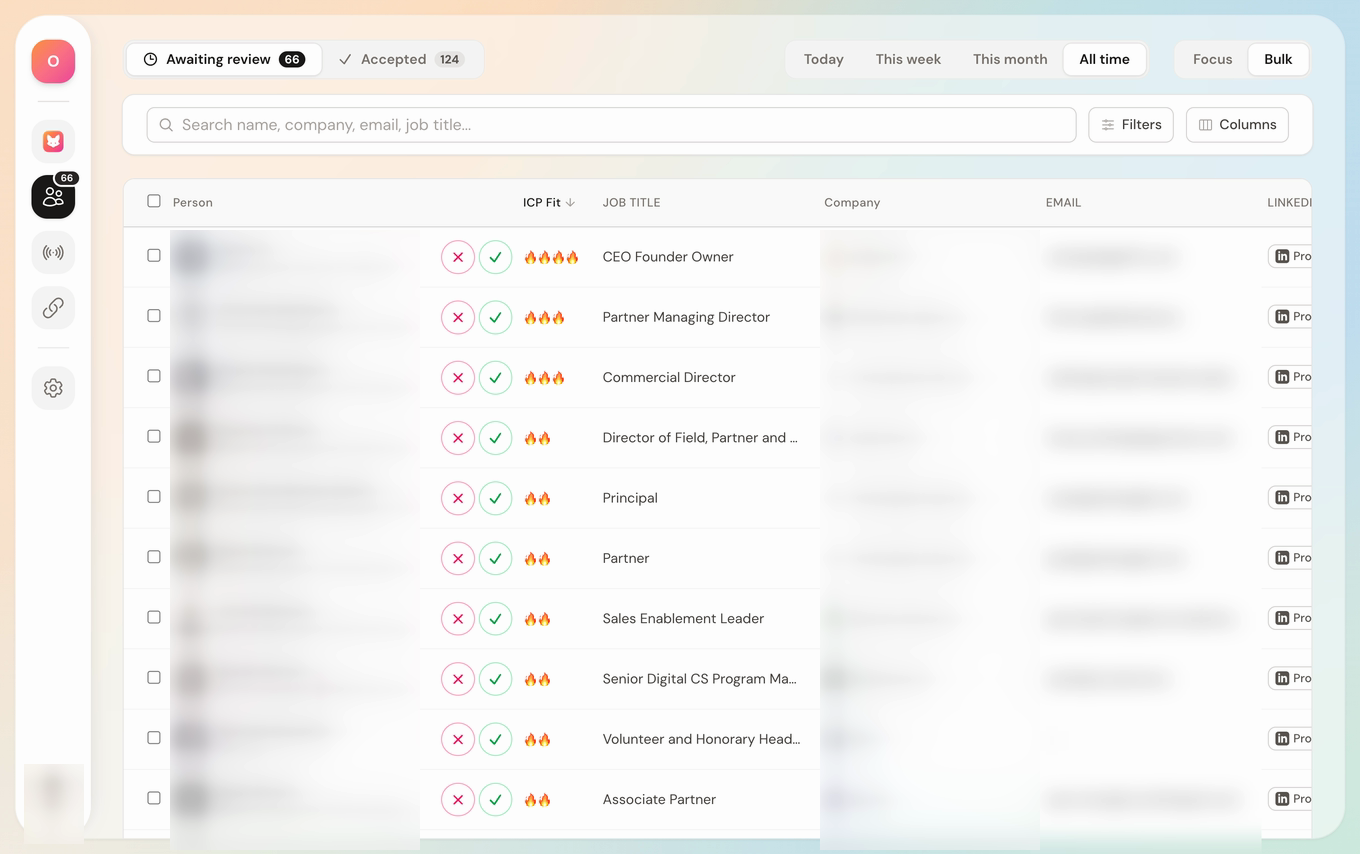
Max ranked leads queue with ICP-fit scores and review controls

From ranked queue to evidence

Open any lead to see the ICP fit and sourcing reason before a human accepts or skips it.

The actual Max product showing a ranked leads queue and an open lead record explaining why the prospect was sourced.
What Max is showing hereIllustrative example
Research queueOne more signal needed

How Max would operate the intent-led lead generation loop

Research

Signal Max verified

For intent-led lead generation, Scout opens one case with this inspectable input: Job change.

Scout gathers job change, preserves the source, and exposes unresolved fields rather than completing them with guesses.

What Max refused to assume

For intent-led lead generation, Max does not assume that an available input deserves repetition, outreach, or scale. The team applies the field note rule instead: Use 0 for absent, 1 for unclear, and 2 for operational. Do not run the playbook when the input, accountable owner, evidence boundary, or stop condition is missing. Repeat only the part supported by the recorded buyer and commercial outcome.

Why it ranks here

For intent-led lead generation, the workflow can organize the case, but the source, account fit, or decision owner still needs verification before a message is useful.

Decision trace: Strategist applies the playbook and records a Research decision with its failed or passed gate.

Recommended next action

A research card for intent-led lead generation, with the missing evidence named and no outreach draft.

Closer prepares no draft while the account is in Research.

Your rep stays in control

A named human reopens the evidence for intent-led lead generation, checks the inference, wording, permission, and suppression rules, then approves or rejects any external action.

Start tomorrow with the right leads.

Use Max to keep the intent-led lead generation decision inspectable while your team retains approval.

Start for free

Cancel anytime

Evidence desk

Research notes and sources

Sources were checked on . Each note states the limited point the source supports, so a benchmark is not mistaken for a promise.

How to read this bibliography

These references support the factual context and methods in this guide. They do not certify every sentence, validate a vendor's marketing claims, or imply that Max ran a hands-on product test. Vendor and industry research can still be useful, but its commercial incentives, sample, geography, and date should remain visible.

  1. Official guidanceEuropean Data Protection Board·Live guidance; accessed 2026-07-21

    Legal Basis (opens in a new tab)

    What it supports
    The requirement to identify a GDPR legal basis before processing personal data and the added constraints around sensitive categories.
    Limit
    High-level EU guidance, not legal advice or a blanket authorization for direct marketing, tracking, enrichment, or outreach in any jurisdiction.
  2. Official guidanceUK Information Commissioner's Office·Live guidance; accessed 2026-07-21

    Business-to-Business Marketing (opens in a new tab)

    What it supports
    The UK distinction between corporate and individual subscribers, how PECR and UK GDPR can apply to B2B direct marketing, transparency, lawful basis, objections, and suppression.
    Limit
    UK regulatory guidance, not legal advice and not a substitute for checking the recipient type, channel, data source, jurisdiction, and current rules.

Methodology

How this brief was built.

Last material update
July 21, 2026. Dates change only when the article itself changes; a new year in the title is not treated as proof of freshness.
How it was built
This guide combines operator workflow steps, campaign packet requirements, human review points, and measurable conversion signals. The examples are teaching scenarios, not claims that a named prospect has private intent.
Limits
Benchmarks are directional, vendor facts can change, and no framework guarantees replies or revenue. Confirm material pricing, platform, legal, and compliance decisions at the primary source.

Questions

Questions buyers ask before acting.

What is intent-led lead generation?

It is a method that combines best-fit account rules with recent, permission-safe evidence of change, then turns the resulting buyer situation into a useful, human-reviewed action. A signal guides investigation; it does not prove purchase intent.

Which intent signals should a team start with?

Start with a small set of public or approved first-party events that map directly to your offer and can be checked by a human. Relevant hires, team buildouts, launches, migrations, or explicit first-party requests are often easier to interpret than opaque scores.

What is the biggest mistake in intent-led outbound?

Treating the signal as proof. Funding does not prove budget for your offer, a job post does not prove a vendor search, and a visit does not identify a buyer. Separate evidence from interpretation and require account fit and human review.

How should a small team measure the playbook?

Track approval, reply quality, useful conversations, resource requests, meetings, qualified opportunities, pipeline, opt-outs, and false positives by signal and segment. Avoid combining every signal into one blended result.

When should software enter the workflow?

After the team can run the process manually and explain its rules. Max can then help monitor approved signals, organize evidence, prioritize the review queue, and prepare drafts, while humans retain the decision to contact.

Make tomorrow morning easier

Start with the right leads at the top of the list.

Use Max to keep the intent-led lead generation decision inspectable while your team retains approval.

Start for free

Cancel anytime