
Outbound that creates inbound intent

Nicolas Finet·Updated 12 min read

The answer in 60 seconds

How should you run this workflow without turning it into generic outbound?

Outbound creates inbound when a well-qualified account receives useful thinking matched to a current business situation and can continue on its own terms. The default is to give a complete, useful idea in the first touch. Ask permission only when a larger, sensitive, or format-dependent asset genuinely cannot fit; then describe it precisely and never turn delivery into a surprise meeting funnel.

Outbound can create inbound behavior when the first contact helps a buyer answer a real question instead of forcing a meeting. A relevant checklist, teardown, benchmark, or comparison gives the prospect a reason to reply, visit, share, or return on their own terms. The asset must earn attention; disguising a pitch as content only adds another step to bad outbound.

Published . Last materially updated .

Source checkUS Federal Trade Commission: CAN-SPAM Act: A Compliance Guide for Business

Open the primary source (opens in a new tab)

Supports
US commercial-email duties including truthful headers and subjects, identification and address requirements, a working opt-out, and responsibility for messages sent on a company's behalf.
Doesn’t prove
US federal guidance, not a universal rule for every recipient or jurisdiction. State, sector, privacy, and non-US requirements may also apply.
Use this guideTurn the workflow into a small, reviewable experiment.Learning goals

Start with the decision

A playbook is a repeatable way to make one commercial decision. Define the input and owner, run one small test, and inspect the result before repeating it.

By the end, you will be able to run this workflow manually on one account, review the output, and decide what, if anything, deserves repetition.

After this guide, you can

  1. 01Define the input, owner, and decision before adding automation.
  2. 02Apply this playbook to this case: Job change.
  3. 03Review evidence, wording, and outcome so the next run gets smarter.

The exercise keeps the first run manual so the team can inspect the reasoning before it repeats the workflow.

1. Understand the asset-first exchange

The first exchange has a simple contract: the seller notices a credible business situation and contributes something that reduces uncertainty before asking for time. That may be a complete check, comparison rule, or finding inside the message. Permission is appropriate only for a larger or sensitive asset that cannot fit. If the value is generic, gated unexpectedly, or followed by pressure, the exchange loses trust.

  • Account fit and safe evidence come before content selection
  • The asset answers one decision question, not every product question
  • The first touch gives value; permission is an exception for assets that cannot fit
  • The promised resource arrives without changing the terms
  • The buyer controls the next step

2. Recognize when an asset will help

Use an asset when the buyer has a real question that can be taught before a sales conversation. A checklist fits readiness, a teardown fits an observable gap, a comparison fits a category decision, and a benchmark fits uncertainty about performance. Do not send content merely because it exists. If the account does not fit or the evidence is weak, nurture or no contact is better.

  • Checklist: the buyer needs to assess readiness or avoid omissions
  • Teardown: a public, specific problem can be explained safely
  • Comparison: the buyer needs decision criteria and trade-offs
  • Benchmark: the buyer needs a reference point with a trustworthy source
  • False positive: content engagement or a weak signal mistaken for a meeting request

3. Turn a verified situation into a useful first step

Imagine a hypothetical small cybersecurity consultancy targeting regional manufacturers. A best-fit manufacturer publicly appoints a compliance lead and announces a new customer requirement. The consultancy can connect the public change to readiness work without assuming a security project. It offers a concise compliance-readiness checklist. If the lead requests it, the resource links to a deeper guide; a conversation is offered only after the buyer asks a specific implementation question.

  • Fit: manufacturer in a serviceable market with the relevant compliance exposure
  • Evidence: public appointment and public customer requirement
  • Do not infer: active procurement, an incident, budget, or incumbent failure
  • Asset: practical readiness checklist with no hidden product pitch
  • Next step: answer the buyer's question, then offer the appropriate route

4. Score the account and the asset together

An excellent asset sent to the wrong account is still poor outreach. Review account fit, signal strength, source permission, problem ownership, asset specificity, evidence quality inside the asset, and the natural next step. Use green, amber, and red decisions a sales manager can inspect. Green means the resource clearly helps this buyer situation; amber requires adaptation or more evidence; red means do not contact.

  • Fit: the account belongs in your market before the signal
  • Timing: the evidence is recent, relevant, and safe to use
  • Ownership: the recipient plausibly owns the question
  • Asset quality: useful without a sales call and honest about its sources
  • Route: a next step exists that matches both buyer readiness and account value

5. Write the value-first and delivery messages

Default first touch: 'Hi [name], [public change] can raise a question about [problem]. One useful check is [complete step], because it separates [case A] from [case B]. Which case matches your current process?' If a larger asset genuinely cannot fit: name its format, scope, and decision it supports, then ask whether that exact resource would help. On a yes, deliver it immediately with no gate, calendar link, or changed terms.

  • Use one observable fact and one conditional implication
  • Put a complete, useful idea in the first message by default
  • Describe any larger asset precisely, then deliver it immediately after an explicit yes
  • Do not add an unexpected calendar link, form, or product deck
  • Ask a diagnostic question only when it helps the buyer navigate the resource

6. Route the buyer by behavior and fit

After delivery, route on what the buyer actually does, not what the original signal supposedly meant. A low-fit reader can stay with educational content. A self-serve buyer can evaluate independently. A buyer asking an implementation question may benefit from an asynchronous walkthrough. A high-fit account requesting help can be offered a human conversation. State the options plainly and avoid pushing everyone into the same demo path.

  • Education: related guide, newsletter, or webinar when the question is early
  • Self-serve: trial or product information when the buyer asks how it works
  • Asynchronous help: annotated example or short walkthrough for a specific question
  • Human conversation: only when fit is strong and the buyer wants help deciding
  • No further action: when relevance is weak, permission is absent, or the buyer declines

7. Measure whether the asset creates buyer value

Track more than opens and clicks. Record accounts reviewed, permission replies, resources requested, meaningful resource engagement where consent allows it, follow-up questions, return visits, meetings, qualified opportunities, pipeline, opt-outs, and complaints. Compare assets by signal and buyer situation. Retire resources that win clicks but do not create useful questions or commercial progression.

  • Engagement: substantive replies and explicit resource requests
  • Education: meaningful engagement, return visits, and follow-up questions
  • Educational-outbound outcomes: meetings, qualified opportunities, and pipeline
  • Safety: opt-outs, complaints, and messages rejected during review
  • Asset health: results by topic, signal, account segment, and route

Bookmark this

The field note

The reusable model, scorecard, and exercise from this guide. Keep them in one place for your next pipeline review.

The mental model

  1. Input01

    One qualified account plus one decision question

    Keep the source, permission, and unresolved unknowns visible.

  2. Decision02

    Give value, nurture, or do not contact

    Write the choice and accountable owner before drafting or automating.

  3. Output03

    One complete check or precisely described asset

    Make the artifact inspectable and usable by a second operator.

  4. Review04

    Useful replies, return visits, pipeline, and opt-outs

    Repeat only when the observed outcome supports the rule.

The 10-point check

  1. InputIs this input complete, permitted, and inspectable: One qualified account plus one decision question?0 · 1 · 2
  2. DecisionIs one named owner accountable for this choice: Give value, nurture, or do not contact?0 · 1 · 2
  3. OutputDoes the run produce this usable artifact: One complete check or precisely described asset?0 · 1 · 2
  4. BoundaryAre evidence limits, exclusions, permissions, and stop conditions explicit?0 · 1 · 2
  5. LearningWill the review keep useful replies, return visits, pipeline, and opt-outs tied to this run?0 · 1 · 2

Use 0 for absent, 1 for unclear, and 2 for operational. Do not run the playbook when the input, accountable owner, evidence boundary, or stop condition is missing. Repeat only the part supported by the recorded buyer and commercial outcome.

Worked gate check

Input to verify
One qualified account plus one decision question
Decision to record
Give value, nurture, or do not contact
Smallest useful output
One complete check or precisely described asset
Evidence for the next review
Useful replies, return visits, pipeline, and opt-outs

20-minute practice

Try it on one account today.

The point is not to automate faster. It is to learn whether the reasoning survives contact with a real account.

  1. 1Choose one real account and assemble only this input: One qualified account plus one decision question.
  2. 2Write the decision before drafting: Give value, nurture, or do not contact.
  3. 3Build exactly one reviewable output: One complete check or precisely described asset.
  4. 4Ask a second operator to challenge the source, permission, evidence boundary, exclusions, and stop condition.
  5. 5Record useful replies, return visits, pipeline, and opt-outs. Repeat only the rule that the evidence supports.
Plain-English glossary
Outbound that creates inbound
The specific operating playbook covered here, bounded to one input, decision, owner, and reviewable output.
Decision owner
The person accountable for the action, exceptions, and review boundary.
Reversible test
A small trial that can stop without committing a large list, budget, or customer relationship.
Campaign asset
A useful object that reduces the recipient's work or uncertainty.
Learning loop
A review of evidence, decisions, outcomes, and corrections before the workflow repeats.
Plain-text field note+

See Max at work

Your best leads, delivered every morning.

Max watches buying signals continuously and ranks who's most likely to convert, so your team knows exactly who to contact first and why.

Actual Max interface

Product captures
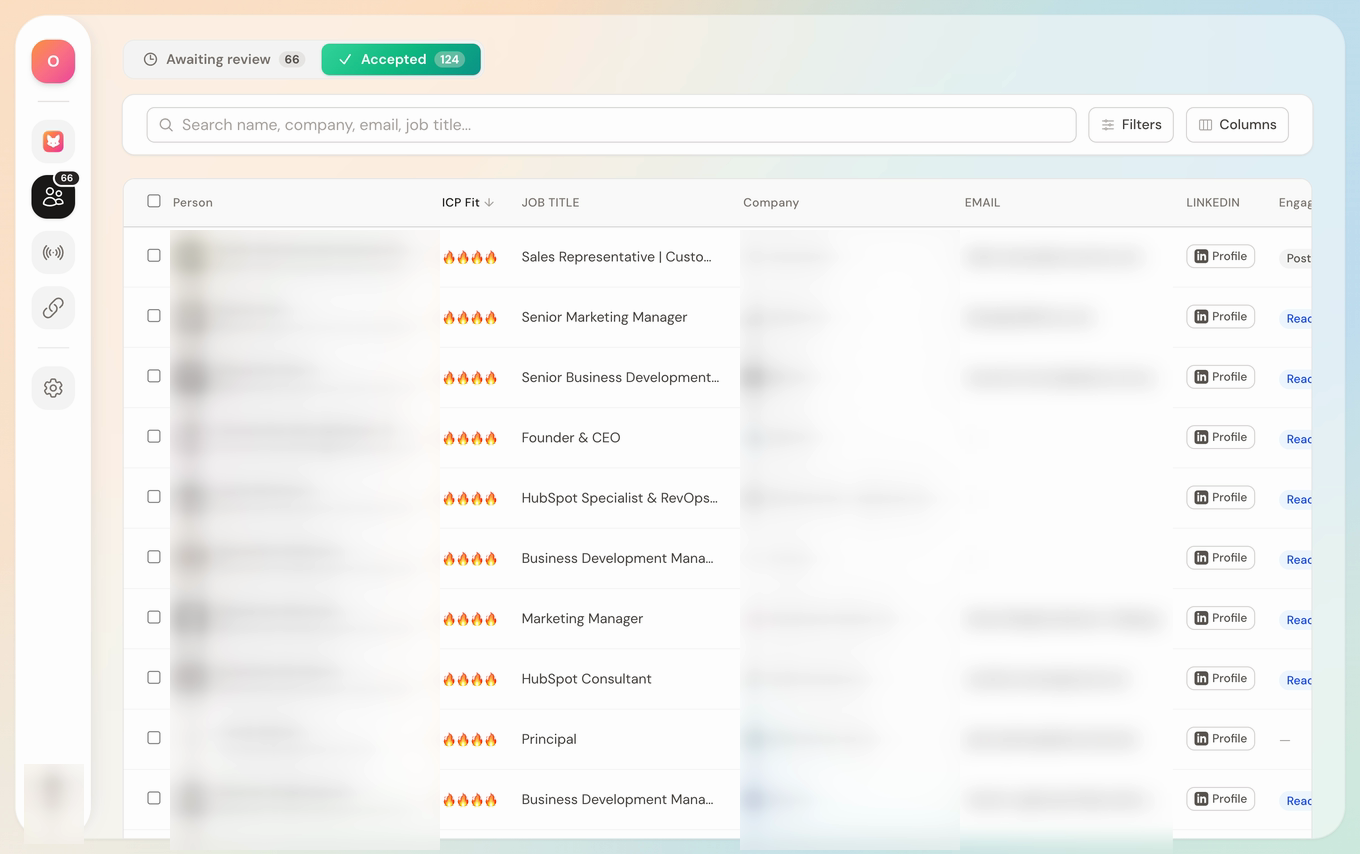
Max accepted-leads queue after human review
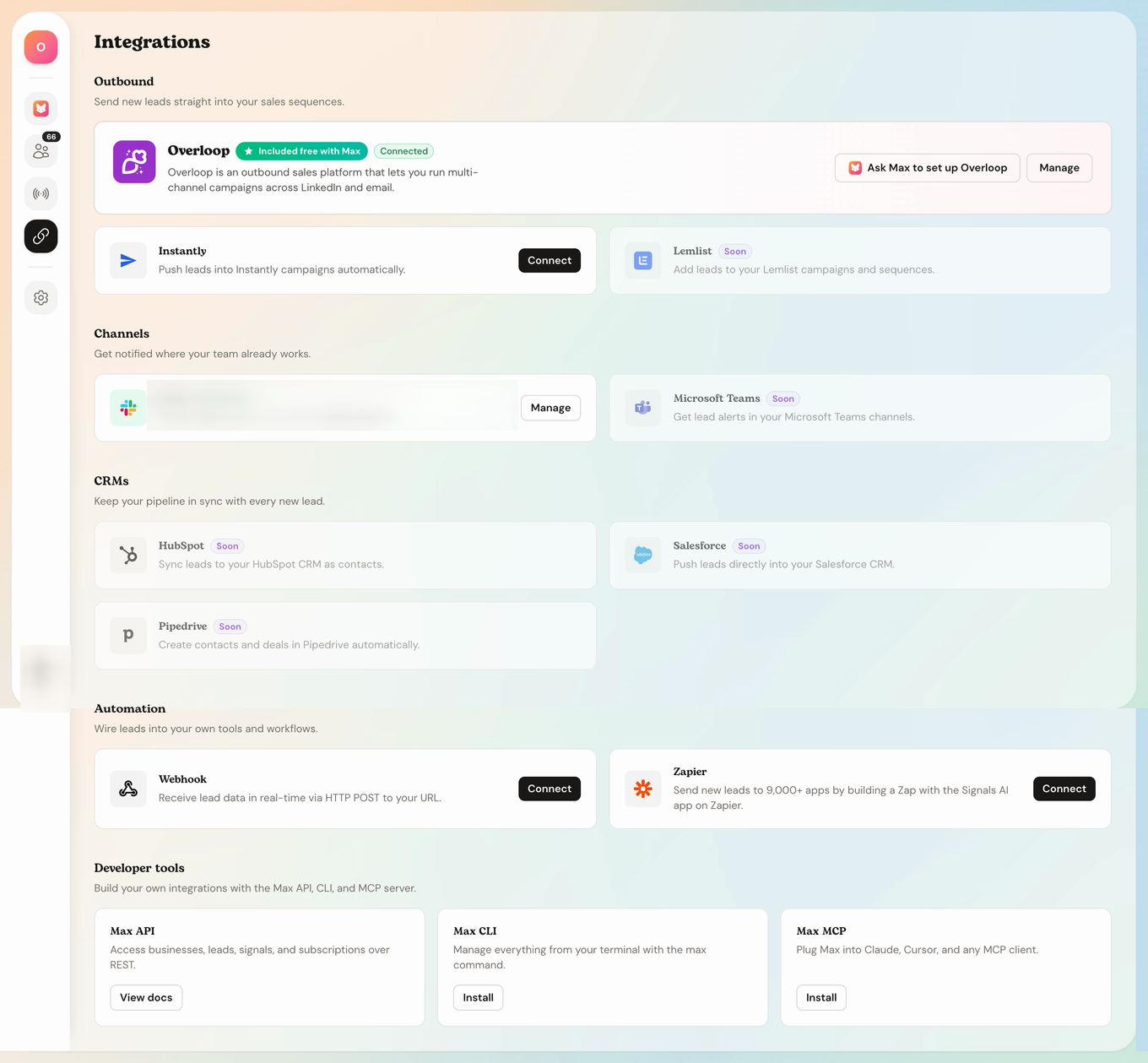
Connected stackOutbound, Slack and CRM
Max integrations screen with outbound, channel, CRM and automation connections

Human review before the handoff

Accepted leads stay separate from the review queue, while integrations carry the approved handoff into the existing stack.

The actual Max accepted-leads queue and integrations screen for outbound, channels, CRM and automation.
What Max is showing hereIllustrative example
WatchlistHeld from today's list

How Max would operate the outbound that creates inbound loop

Wait

Signal Max verified

For outbound that creates inbound, Scout opens one case with this inspectable input: Job change.

Scout gathers job change, preserves the source, and exposes unresolved fields rather than completing them with guesses.

What Max refused to assume

For outbound that creates inbound, Max does not assume that an available input deserves repetition, outreach, or scale. The team applies the field note rule instead: Use 0 for absent, 1 for unclear, and 2 for operational. Do not run the playbook when the input, accountable owner, evidence boundary, or stop condition is missing. Repeat only the part supported by the recorded buyer and commercial outcome.

Why it ranks here

For outbound that creates inbound, the method is usable, but the current case does not yet clear the playbook's written decision rule. Max records what would change the status.

Decision trace: Strategist applies the playbook and records a Wait decision with its failed or passed gate.

Recommended next action

A dated watch record for outbound that creates inbound, including the next evidence check and no outreach draft.

Closer prepares no draft while the account is in Wait.

Your rep stays in control

A named human reopens the evidence for outbound that creates inbound, checks the inference, wording, permission, and suppression rules, then approves or rejects any external action.

Start tomorrow with the right leads.

Use Max to keep the outbound that creates inbound decision inspectable while your team retains approval.

Start for free

Cancel anytime

Evidence desk

Research notes and sources

Sources were checked on . Each note states the limited point the source supports, so a benchmark is not mistaken for a promise.

How to read this bibliography

These references support the factual context and methods in this guide. They do not certify every sentence, validate a vendor's marketing claims, or imply that Max ran a hands-on product test. Vendor and industry research can still be useful, but its commercial incentives, sample, geography, and date should remain visible.

  1. Official guidanceUS Federal Trade Commission·Live guidance; accessed 2026-07-21

    CAN-SPAM Act: A Compliance Guide for Business (opens in a new tab)

    What it supports
    US commercial-email duties including truthful headers and subjects, identification and address requirements, a working opt-out, and responsibility for messages sent on a company's behalf.
    Limit
    US federal guidance, not a universal rule for every recipient or jurisdiction. State, sector, privacy, and non-US requirements may also apply.
  2. Official guidanceUK Information Commissioner's Office·Live guidance; accessed 2026-07-21

    Business-to-Business Marketing (opens in a new tab)

    What it supports
    The UK distinction between corporate and individual subscribers, how PECR and UK GDPR can apply to B2B direct marketing, transparency, lawful basis, objections, and suppression.
    Limit
    UK regulatory guidance, not legal advice and not a substitute for checking the recipient type, channel, data source, jurisdiction, and current rules.

Methodology

How this brief was built.

Last material update
July 28, 2026. Dates change only when the article itself changes; a new year in the title is not treated as proof of freshness.
How it was built
This guide combines operator workflow steps, campaign packet requirements, human review points, and measurable conversion signals. The examples are teaching scenarios, not claims that a named prospect has private intent.
Limits
Benchmarks are directional, vendor facts can change, and no framework guarantees replies or revenue. Confirm material pricing, platform, legal, and compliance decisions at the primary source.

Questions

Questions buyers ask before acting.

Why use assets in cold outbound?

A strong asset lets the seller create value before requesting time. It gives the buyer a small, reversible next step and makes expertise inspectable. It works only when the account, evidence, question, and resource genuinely match.

What asset should I send first?

Choose the asset that answers the immediate decision: a readiness checklist, public-evidence teardown, comparison, benchmark, or implementation map. Do not start from the content library; start from the buyer question.

Should the first message include a link?

Yes, when the useful part fits and the link is expected, direct, safe, and ungated. Otherwise give one complete idea in the message and describe the larger resource before asking whether it would help. Never hide a form, tracking surprise, or meeting request behind the link.

What is the biggest asset-first mistake?

Sending generic content to a weakly qualified account and treating a click as purchase intent. The resource must answer a specific question, and later action should follow the buyer's explicit behavior rather than an assumption.

Where can software help in this playbook?

First design the fit, evidence, asset, routing, review, and measurement rules manually. Max can then help match approved situations to resources and prepare messages, while a human controls contact and the next-step recommendation.

Make tomorrow morning easier

Start with the right leads at the top of the list.

Use Max to keep the outbound that creates inbound decision inspectable while your team retains approval.

Start for free

Cancel anytime