
Build a signal selling operating system in 30 days

Nicolas Finet·Updated 16 min read

The answer in 60 seconds

How should you run this workflow without turning it into generic outbound?

A 30-day signal selling operating system has four phases: define one testable ICP in days 1 to 5, document up to three signals and their false positives in days 6 to 10, review 20 accounts and send only the strongest human-approved messages in days 11 to 20, then use buyer corrections, trust outcomes, and commercial results to scale, change, wait, or stop in days 21 to 30. These numbers are conservative starting constraints for a manager-reviewed first run, not universal benchmarks.

Signal selling becomes useful when a small team can repeat the judgment, not merely detect more events. This playbook gives a founder or sales leader one month to define fit, choose a few inspectable signals, review a small account queue, write useful first touches, and decide what deserves to scale. Every phase is explained here so the team can run it with the tools it already uses.

Published . Last materially updated .

Source checkEuropean Data Protection Board: Legal Basis

Open the primary source (opens in a new tab)

Supports
The requirement to identify a GDPR legal basis before processing personal data and the added constraints around sensitive categories.
Doesn’t prove
High-level EU guidance, not legal advice or a blanket authorization for direct marketing, tracking, enrichment, or outreach in any jurisdiction.
Use this guideTurn the workflow into a small, reviewable experiment.Learning goals

Start with the decision

A playbook is a repeatable way to make one commercial decision. Define the input and owner, run one small test, and inspect the result before repeating it.

By the end, you will be able to run this workflow manually on one account, review the output, and decide what, if anything, deserves repetition.

After this guide, you can

  1. 01Define the input, owner, and decision before adding automation.
  2. 02Apply this playbook to this case: One evidence-backed ICP with explicit exclusions.
  3. 03Review evidence, wording, and outcome so the next run gets smarter.

The exercise keeps the first run manual so the team can inspect the reasoning before it repeats the workflow.

1. Start with one decision the system must improve

Do not begin with a feed of signals. Begin with the recurring decision a manager currently finds hard, such as which five accounts deserve careful research this week. Name the owner, the input, the safe output, and the review cadence. The system is successful only if two operators can inspect the same evidence and reach a similar lane for a defensible reason.

  • Decision: which best-fit accounts deserve a human-reviewed first touch now?
  • Owner: one person accountable for exceptions, suppression, and the weekly review
  • Unit of work: one account, one signal route, one owner, one useful asset
  • Output: launch, research, wait, or stop, with the reason stored beside the evidence

2. Days 1 to 5: write an ICP two people can apply

Use retained customers, expanded accounts, lost deals, churned customers, and implementation notes to write account-level rules. Include why the company can benefit and why it is viable to serve. Exclude accounts that look attractive on firmographics but repeatedly fail on economics, access, delivery, compliance, or ownership. Then ask two people to classify the same ten accounts without seeing each other's answers. If a young company lacks this history, label the ICP provisional, use founder call notes and five to ten buyer interviews from one narrow segment, keep every rule in Draft, and delay scaling until real cases confirm or reject it.

  • Write three inclusion rules and three exclusion rules
  • Separate company fit from buyer persona and timing
  • Record the evidence source behind every rule
  • With thin history, mark each rule provisional and name the next interview or case that could disprove it
  • Resolve classification disagreements before collecting signals

3. Days 6 to 10: build a signal registry, not a trigger list

Choose at most three signals for the first month. Each row in the registry needs an allowed source, the exact evidence to capture, an ordinary false positive, a separate corroborating clue, a likely workstream owner, a mention policy, a useful contribution, and a default action. A job post, website visit, funding notice, and public comment should not share the same evidence rule or message policy.

  • Public event: the event may be named accurately once, while its meaning stays conditional
  • Public topic: discuss the business topic, not the person's tracked action
  • Hidden trigger: keep the trigger out of the message and require separate public context
  • Stop when the source, permission, recency, account fit, or ordinary explanation fails

4. Turn the account queue into a visible judgment

Score ICP fit, evidence, corroboration, owner clarity, and buyer value from zero to two. The total exposes missing work, but three hard gates sit above it: ICP fit, permission, and safe wording. An ICP fit of zero or either safety failure always produces Stop; incomplete fit stays in Research. Only a fully fitting account with eight to ten points can enter Launch, five to seven means Research, and zero to four means Wait. These thresholds are editable editorial defaults for one inspectable first run, not a universal intent score or a benchmark supported by the privacy sources below.

  • Launch: evidence and value are strong enough for human message review
  • Research: the account fits but one important evidence gap remains
  • Wait: the timing, owner, or useful next step is not clear
  • Stop: poor fit, unsafe source, failed permission, opt-out, or unfixable wording

5. Days 11 to 20: write for a reply, not a meeting

A strong first touch needs only four inputs: one verified public fact with its date, one possible operating implication stated conditionally, one useful check given in the message, and one natural question the reader can answer without accepting a call. Keep the first batch to five or ten messages. The advanced prompt is useful when a larger team also needs source policy, corroboration, owner routing, exclusions, and a formal review record.

  • Name only what the source proves
  • Use one uncertainty marker, not a paragraph of disclaimers
  • Give the checklist step, distinction, or example now
  • Ask one short question whose answer changes the next response
  • Remove the meeting request, calendar link, praise opener, and empty bump

6. Put a human approval gate before the first send

The reviewer reopens the source, checks its date and allowed use, tries to explain the event innocently, confirms the recipient plausibly owns the work, and reads the message from the buyer's point of view. The reviewer can approve, edit, research, wait, or stop. Approval is attached to the exact account and draft, not granted to an entire signal category.

  • Fact and hypothesis appear in separate fields
  • The recipient can understand why the note is relevant without feeling monitored
  • The useful contribution stands on its own if the commercial hypothesis is wrong
  • Customers, competitors, sensitive contexts, and opt-outs remain suppressed

7. Days 21 to 30: count learning and trust beside pipeline

A buyer correction is useful evidence, not a failed personalization token. Record whether the hypothesis was confirmed, corrected, or rejected. Count helpful replies, qualified replies, negative replies, opt-outs, complaints, opportunities, pipeline, and suppressions with stable denominators. Compare results by signal and segment only after the sample and review method are visible.

  • Queue health: reviewed, launched, researched, waited, and stopped
  • Buyer value: helpful answers, follow-up questions, and asset use
  • Trust: corrections, negative replies, opt-outs, complaints, and suppressions
  • Commercial outcome: qualified conversations, opportunities, and pipeline

8. A small-team Benelux example

Imagine a Belgian B2B software company with a founder, one sales lead, and two account executives. It targets Benelux firms building their first outbound team. The first registry uses live job postings, public leadership changes, and permissioned account-level website activity. Job posts may be named once. Website activity never appears in the copy. The team reviews 20 accounts, launches six messages, and reads every answer together on Friday. It uses the language the recipient uses publicly for work; English is the fallback only when that is the company's stated working language or no local preference can be verified. A fluent reviewer approves every French or Dutch version.

  • English fact: the company published two SDR roles on its careers page
  • Conditional implication: the team may be standardizing ramp before the new reps start
  • Value now: a three-question ramp check included in the note
  • Question: Where do new reps learn those three answers today before their first live call?
  • English note: Northstar opened two SDR roles this month. A quick ramp check is whether every new rep can explain who you help, why now, and which proof to use in under 30 seconds. Where do new reps learn those three answers today before their first live call?
  • French note: Northstar a publié deux postes de SDR ce mois-ci. Un test simple avant leur arrivée: chaque nouvelle recrue sait-elle expliquer en 30 secondes qui vous aidez, pourquoi maintenant et quelle preuve utiliser? Comment ces réponses sont-elles apprises aujourd'hui, si elles le sont: playbook, écoute d'appels ou autrement?
  • Dutch note: Northstar heeft deze maand twee SDR-vacatures gepubliceerd. Een eenvoudige onboardingcheck voor hun start: kan elke nieuwe verkoper in minder dan 30 seconden uitleggen wie jullie helpen, waarom nu en welk bewijs past? Hoe leren nieuwe collega's die antwoorden vandaag, als dat al gebeurt: via een playbook, calls meeluisteren of op een andere manier?
  • Decision: repeat only if fit, source quality, buyer value, and trust outcomes remain acceptable

9. Finish with one written operating decision

At day 30, do not ask whether signal selling worked in the abstract. Ask which account rule, signal, owner, asset, and question produced the most useful evidence. Keep the strongest rule, change only one weak assumption, wait when the sample is inconclusive, and stop any route that creates unacceptable trust or permission risk. Keep teaching examples separate from live records so the weekly review never mistakes demonstration data for results.

  • Scale: the rule is reproducible and buyer value remains strong
  • Change: one named assumption is weak and a reversible next test exists
  • Wait: the sample or timing is too thin for a conclusion
  • Stop: trust, permission, fit, or economics fail the written gate

Bookmark this

The field note

The reusable model, scorecard, and exercise from this guide. Keep them in one place for your next pipeline review.

The mental model

  1. Input01

    One narrow ICP, up to three inspectable signals, and a 20-account queue

    Keep the source, permission, and unresolved unknowns visible.

  2. Decision02

    Launch, research, wait, or stop after the hard gates

    Write the choice and accountable owner before drafting or automating.

  3. Output03

    A reviewed account lane, useful first touch, and written reason

    Make the artifact inspectable and usable by a second operator.

  4. Review04

    Buyer corrections, trust outcomes, opportunities, and pipeline by signal

    Repeat only when the observed outcome supports the rule.

The 10-point check

  1. InputIs this input complete, permitted, and inspectable: One narrow ICP, up to three inspectable signals, and a 20-account queue?0 · 1 · 2
  2. DecisionIs one named owner accountable for this choice: Launch, research, wait, or stop after the hard gates?0 · 1 · 2
  3. OutputDoes the run produce this usable artifact: A reviewed account lane, useful first touch, and written reason?0 · 1 · 2
  4. BoundaryAre evidence limits, exclusions, permissions, and stop conditions explicit?0 · 1 · 2
  5. LearningWill the review keep buyer corrections, trust outcomes, opportunities, and pipeline by signal tied to this run?0 · 1 · 2

Use 0 for absent, 1 for unclear, and 2 for operational. Do not run the playbook when the input, accountable owner, evidence boundary, or stop condition is missing. Repeat only the part supported by the recorded buyer and commercial outcome.

Worked gate check

Input to verify
One narrow ICP, up to three inspectable signals, and a 20-account queue
Decision to record
Launch, research, wait, or stop after the hard gates
Smallest useful output
A reviewed account lane, useful first touch, and written reason
Evidence for the next review
Buyer corrections, trust outcomes, opportunities, and pipeline by signal

20-minute practice

Try it on one account today.

The point is not to automate faster. It is to learn whether the reasoning survives contact with a real account.

  1. 1Choose one real account and assemble only this input: One narrow ICP, up to three inspectable signals, and a 20-account queue.
  2. 2Write the decision before drafting: Launch, research, wait, or stop after the hard gates.
  3. 3Build exactly one reviewable output: A reviewed account lane, useful first touch, and written reason.
  4. 4Ask a second operator to challenge the source, permission, evidence boundary, exclusions, and stop condition.
  5. 5Record buyer corrections, trust outcomes, opportunities, and pipeline by signal. Repeat only the rule that the evidence supports.
Plain-English glossary
30-day signal selling operating system
The specific operating playbook covered here, bounded to one input, decision, owner, and reviewable output.
Decision owner
The person accountable for the action, exceptions, and review boundary.
Reversible test
A small trial that can stop without committing a large list, budget, or customer relationship.
Campaign asset
A useful object that reduces the recipient's work or uncertainty.
Learning loop
A review of evidence, decisions, outcomes, and corrections before the workflow repeats.
Plain-text field note+

See Max at work

Your best leads, delivered every morning.

Max watches buying signals continuously and ranks who's most likely to convert, so your team knows exactly who to contact first and why.

Actual Max interface

Product captures
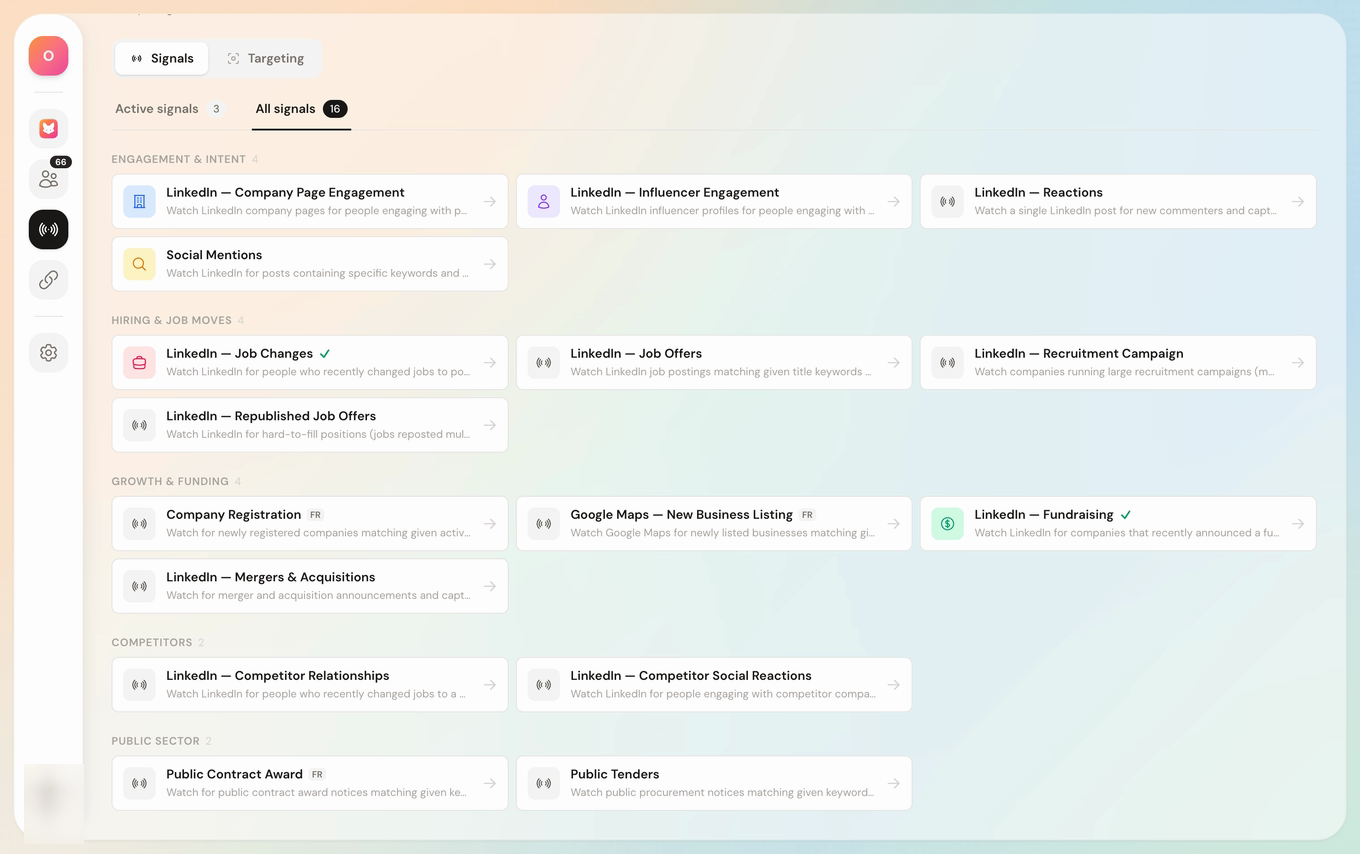
Max signal library grouped by engagement, hiring, growth, competitors and public-sector events
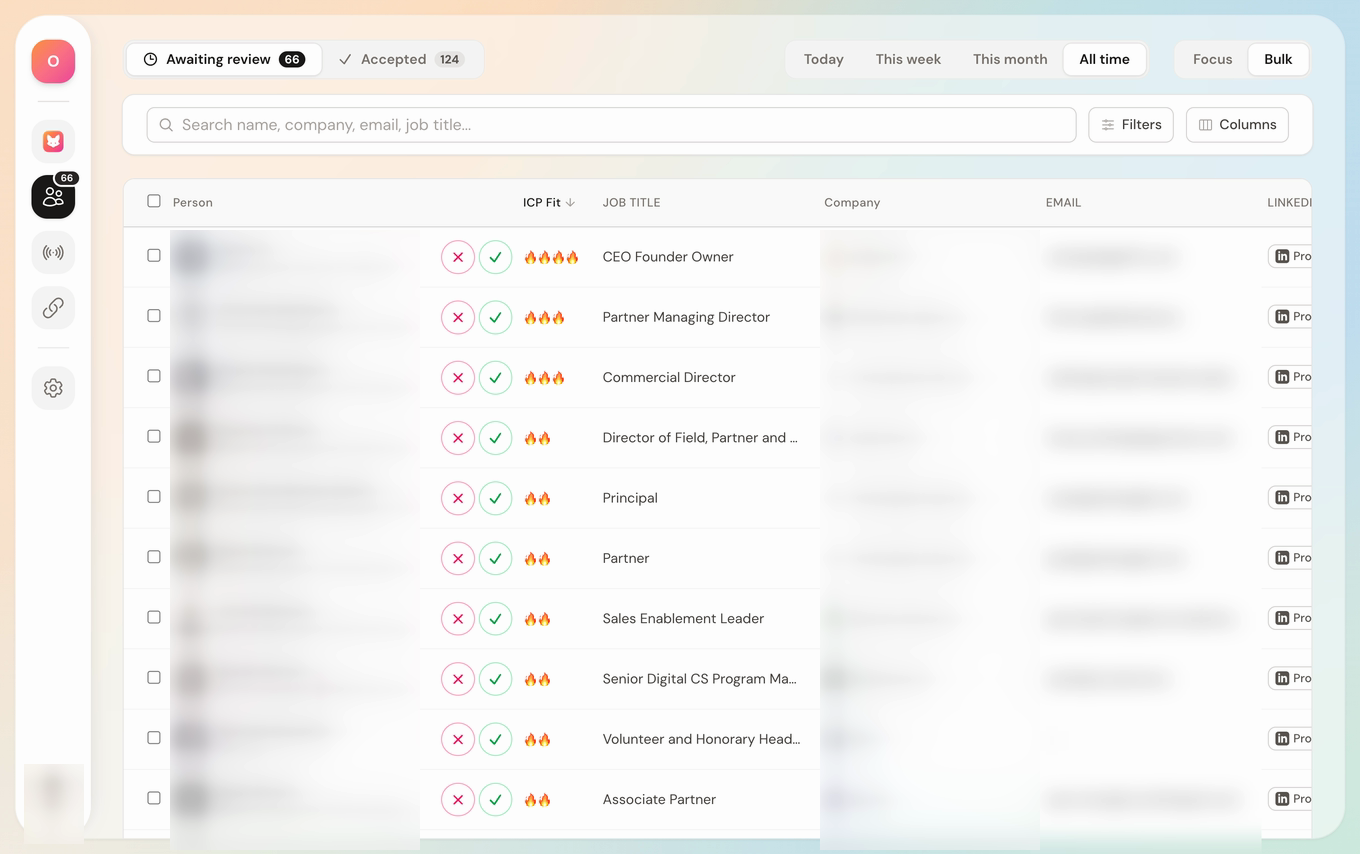
Morning queueRanked for review
Max ranked leads queue with ICP-fit scores and review controls

Configure the system, then review its output

Start with explicit signal sources, then use the ranked queue to decide which leads deserve attention that day.

The actual Max signal library and ranked leads queue used in a daily signal-selling workflow.
What Max is showing hereIllustrative example
#1 · Contact firstReady for your review

What Max would put in Monday's operating queue

Launch

Signal Max verified

Scout reviews one account in the 20-account lane and attaches two independent public facts, the ICP rule, source dates, likely owner, mention policy, and one explicit false-positive check.

Scout builds the evidence card and removes weak-fit or uncorroborated accounts before the operating review.

What Max refused to assume

Max does not launch the account because a score is high or because two events happened near each other. Both facts must support the same operating implication and the help must stand on its own.

Why it ranks here

This illustrative account clears fit, source, corroboration, buyer-value, and trust gates. Strategist records why it enters Launch while the other accounts remain in Research, Wait, or Stop.

Decision trace: Strategist assigns Launch to this account only and keeps the full reason visible beside the other queue decisions.

Recommended next action

One review-ready first touch containing a useful three-question check, plus the source trail, uncertain hypothesis, owner, status reason, and written stop condition.

Closer prepares one concise first touch from the approved evidence and asset. The message remains unapproved.

Your rep stays in control

A named human reopens the evidence for signal selling operating system, checks the inference, wording, permission, and suppression rules, then approves or rejects any external action.

Start tomorrow with the right leads.

Use Max to turn the manual review process into one inspectable queue for your team.

Start for free

Cancel anytime

Evidence desk

Research notes and sources

Sources were checked on . Each note states the limited point the source supports, so a benchmark is not mistaken for a promise.

How to read this bibliography

These references support the factual context and methods in this guide. They do not certify every sentence, validate a vendor's marketing claims, or imply that Max ran a hands-on product test. Vendor and industry research can still be useful, but its commercial incentives, sample, geography, and date should remain visible.

  1. Official guidanceEuropean Data Protection Board·Live guidance; accessed 2026-07-21

    Legal Basis (opens in a new tab)

    What it supports
    The requirement to identify a GDPR legal basis before processing personal data and the added constraints around sensitive categories.
    Limit
    High-level EU guidance, not legal advice or a blanket authorization for direct marketing, tracking, enrichment, or outreach in any jurisdiction.
  2. Official guidanceUK Information Commissioner's Office·Live guidance; accessed 2026-07-21

    Business-to-Business Marketing (opens in a new tab)

    What it supports
    The UK distinction between corporate and individual subscribers, how PECR and UK GDPR can apply to B2B direct marketing, transparency, lawful basis, objections, and suppression.
    Limit
    UK regulatory guidance, not legal advice and not a substitute for checking the recipient type, channel, data source, jurisdiction, and current rules.
  3. Official guidanceUS National Institute of Standards and Technology·Live framework page; accessed 2026-07-21

    NIST Privacy Framework (opens in a new tab)

    What it supports
    A risk-based structure for identifying, governing, controlling, communicating, and protecting privacy risk when personal data enters an operational workflow.
    Limit
    Voluntary US framework, not a direct-marketing authorization, jurisdiction-specific compliance checklist, or legal safe harbor.

Methodology

How this brief was built.

Last material update
July 21, 2026. Dates change only when the article itself changes; a new year in the title is not treated as proof of freshness.
Recorded evidence boundary
The operating system treats a signal as reviewable evidence, never as proof of budget, urgency, dissatisfaction, private intent, or willingness to receive outreach.
How it was built
This guide combines operator workflow steps, campaign packet requirements, human review points, and measurable conversion signals. The examples are teaching scenarios, not claims that a named prospect has private intent.
Limits
Benchmarks are directional, vendor facts can change, and no framework guarantees replies or revenue. Confirm material pricing, platform, legal, and compliance decisions at the primary source.

Questions

Questions buyers ask before acting.

What is a signal selling operating system?

It is the repeatable process that turns an observable account change into a reviewable decision. It defines account fit, allowed evidence, false positives, corroboration, owner, buyer value, message policy, human approval, and outcome measurement before the workflow scales.

How many signals should a small team start with?

Start with one to three signals whose original sources your team can reopen and whose false positives are meaningfully different. A small registry creates faster learning than a broad score made from unrelated events.

Does a Launch lane mean the account can be contacted automatically?

No. Launch means the evidence and value are ready for a named human to review the exact recipient and message. Permission, safe wording, suppression, and factual accuracy remain hard gates for every account.

Which metrics belong on the manager dashboard?

Track accounts reviewed, lane decisions, messages sent, helpful and qualified replies, buyer corrections, negative replies, opt-outs, complaints, opportunities, pipeline, and false positives. Keep the signal and segment attached to each outcome.

Can this process be run without Max?

Yes. Run the first month manually in the tools your team already uses so everyone can inspect the reasoning. Then decide which verified parts are worth supporting with software.

Make tomorrow morning easier

Start with the right leads at the top of the list.

Use Max to turn the manual review process into one inspectable queue for your team.

Start for free

Cancel anytime